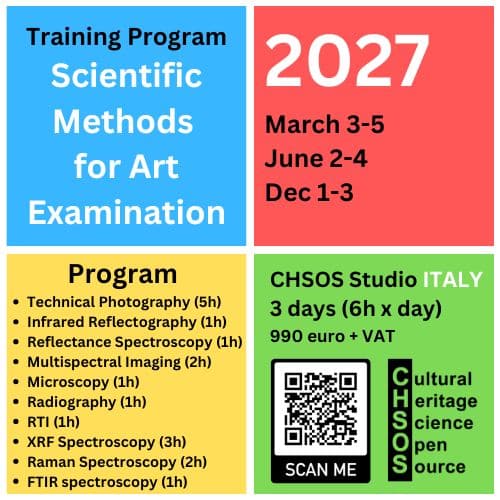
MSI – UV Fluorescence Photography with Antonello
Map Fluorescent Materials with Antonello
Antonello’s Filters can be used not only for reflectance-based multispectral imaging, but also for a range of complementary optical methods. In this lesson, we focus on Ultraviolet Fluorescence Photography, using Antonello filters operating in the visible spectral range to document and map fluorescent materials.
When a surface is illuminated with ultraviolet radiation, certain pigments, binders, varnishes, and restoration materials emit visible light through fluorescence. By carefully selecting Antonello’s visible-range filters, it is possible to isolate this emitted light while efficiently blocking the reflected UV, producing clean and reliable fluorescence images. This approach allows the spatial mapping of fluorescent pigments and materials, revealing information that is often invisible under normal illumination.
The lesson introduces both basic and advanced UV fluorescence workflows using Antonello as a Multispectral Imaging System. Beyond simple documentation, the system enables systematic comparison between different spectral bands, improving the interpretation of fluorescence intensity and distribution across the artwork. This is particularly useful for identifying retouchings, varnish layers, organic materials, and modern interventions.
By integrating ultraviolet excitation with controlled spectral filtering, Antonello provides a flexible and reproducible framework for UV fluorescence photography, making it a powerful tool for conservation studies, technical art history, and scientific documentation.

Scientific Art Examination – Resources:
Getty Conservation Institute (GCI) – USA
The British Museum – Scientific Research Department – UK
Scientific Research Department – The Metropolitan Museum of Art, New York, USA
C2RMF (Centre de Recherche et de Restauration des Musées de France) – France
Rijksmuseum – Science Department – Netherlands