Fabrizio - the Ultraviolet lamp for Art and Archaeology Examination
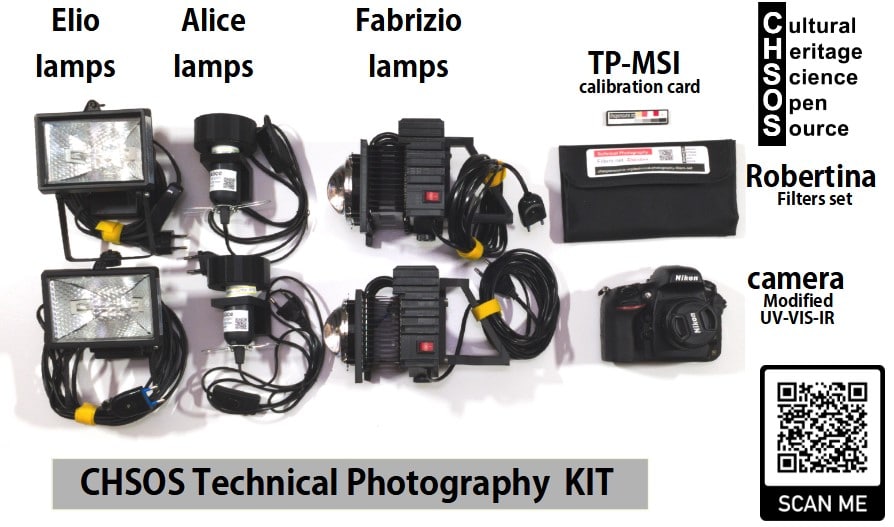
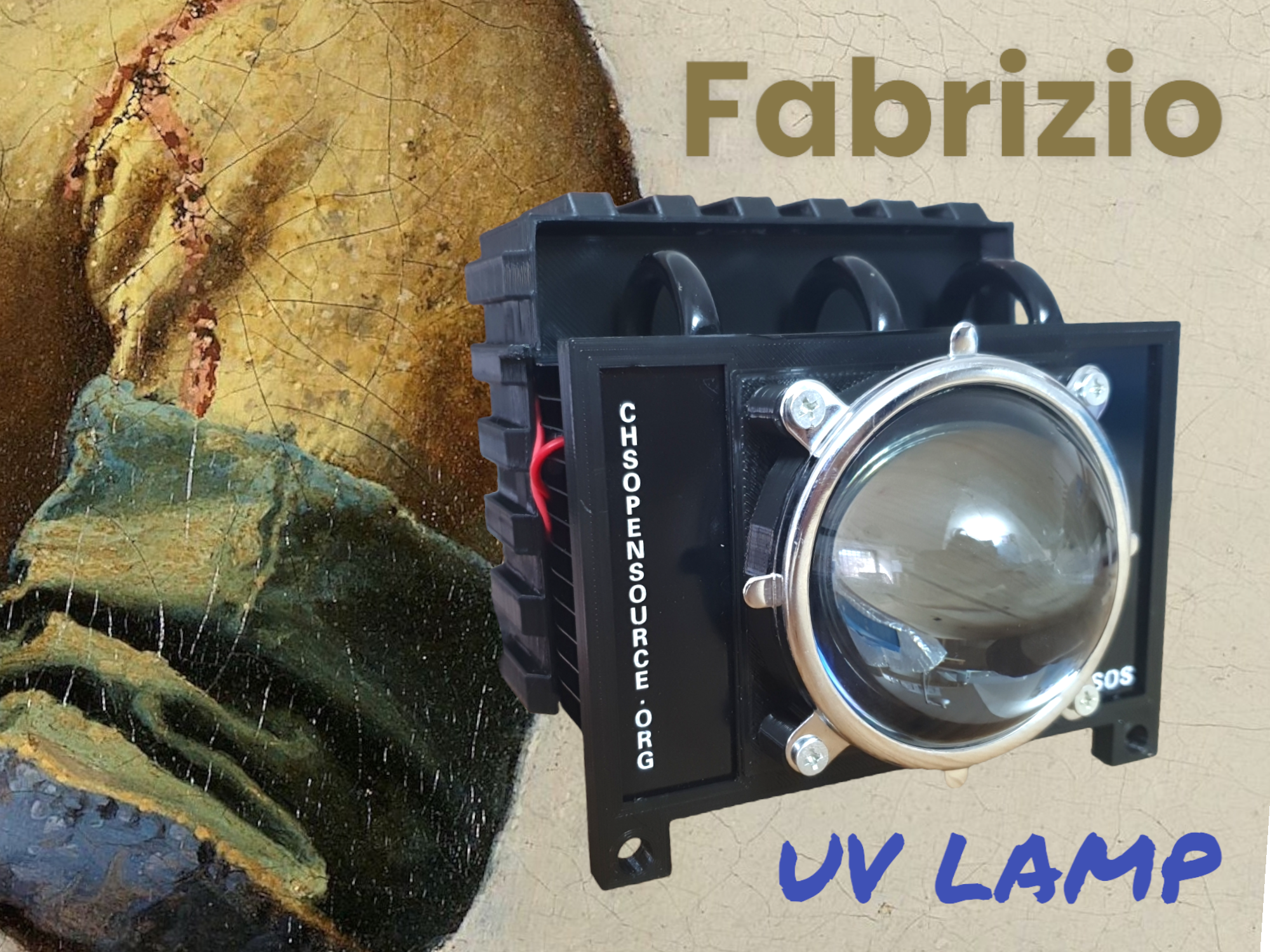
Fabrizio is a UV lamp specifically designed for cultural heritage professionals. At CHSOS, we tested several UV lamps already on the market, but none met our standards. Fabrizio combines all the features required for daily art examination, conservation, and scientific research.
Table of Contents
Specifications
Weight: 1,5 Kg (3,3 pounds). Size: 16 x 14 x 14,5 cm. UV LED radiation power: 14250 mW. UV LED lifespan: 30000 – 50000 hours. Max spectral emission: 365 nm. Focusing lens angle: 60°. Visible-Infrared noise emission: not detectable, UV pass filter cuts off the violet light and infrared radiation. Standard photographic tripod adapter: yes. Power cord: 5 m.
UV LED Technology
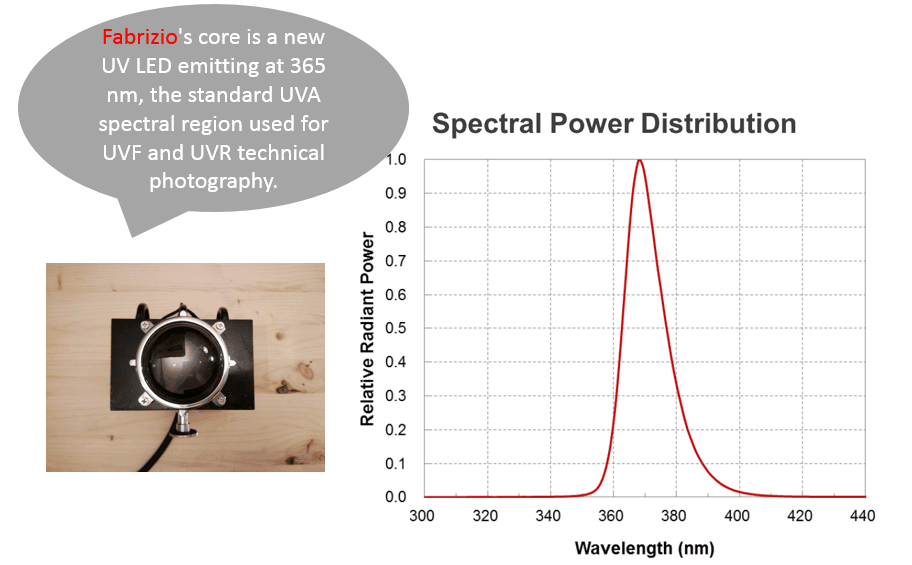
Fabrizio’s core is a UV LED emitting at 365 nm, the standard UVA spectral region used for UVF and UVR technical photography.
Fabrizio boasts a stunningly strong radiant power of 14,250 mW, which distributes across a large surface. This impressive power is achieved thanks to the new AlInGaN-based thin-film vertical LED chip technology. Fabrizio features a grid of 10 series by 5 parallel micro LEDs, with a total power consumption of 50W and 1500 mA operating at 32V.
Illuminated area
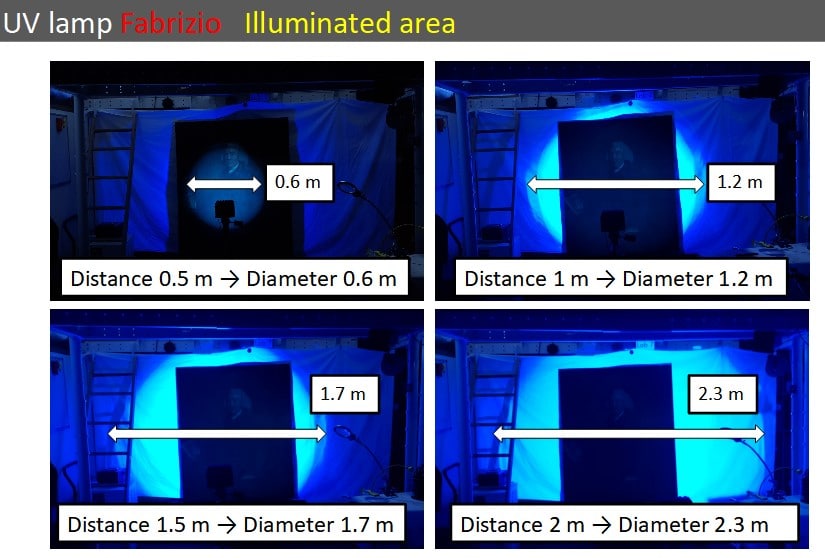
Fabrizio mounts a 60-degree focusing lens and delivers even and intense UV radiation over a 60-degree angle. Using the math of a right-angled triangle we can calculate the Diameter of the irradiated circle as a function of the Distance lamp-surface.
The formula is: Diameter = 1.16 x Distance
These are some example (rounded) values:
Distance 0.5 m -> Diameter 0.6 m
Distance 1 m -> Diameter 1.2 m
Distance 1,5 m -> Diameter 1.7 m
Distance 2 m -> Diameter 2,3 m
High-quality pure UV output
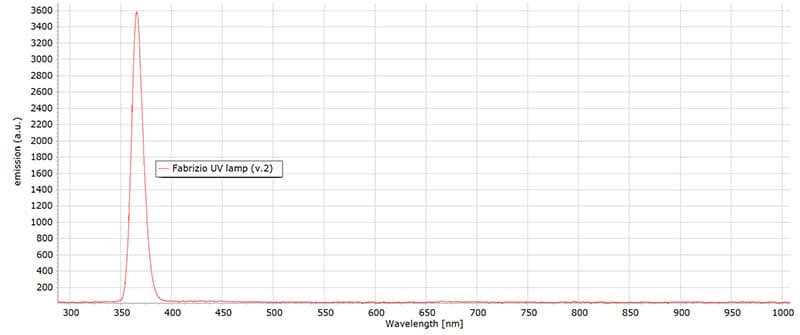
Fabrizio is equipped with a special filter that eliminates all visible light and infrared radiation, allowing only suitable UV radiation for perfect UVF photos. While the UV LEDs produce UV radiation, they also generate unwanted visible light and infrared radiation, which our filter effectively removes.
Fabrizio’s special filter cuts off all violet light, allowing only the suitable UV radiation for perfect UVF photos.
Fabrizio is for Traveling Professionals
Fabrizio’s electronic components accept both international voltage standards, 110 V and 220 V, allowing you to use Fabrizio in any country. Weighing just 1.5 kg (3.3 pounds) and measuring 16 x 14 x 14.5 cm, Fabrizio is both lightweight and compact.
Standard photo tripod adapter
Fabrizio features a handle and an adapter compatible with photographic tripods, similar to a camera. This design allows for versatile handling of the lamp, making it suitable for use on scaffolding, on-site environments, and in laboratory settings.
Applications
- Applications. Case studies and ideas on how to use your Fabrizio UV lamp.
- Fabrizio VS the Fluorescent Worlds. Our Series about applications other than Art Examination.
FAQs
How does the Fabrizio UV lamp perform in comparison with standard UV tubes in terms of intensity?
It depends on the UV tubes you are using. Fabrizio’s radiant power is 14,250 mW. You should check the radiant power value for your UV tubes. However, UV LED lamps like Fabrizio are preferred over traditional UV fluorescent tubes for several reasons. UV LED lamps are much smaller, lightweight, and more portable than UV fluorescent tubes. Additionally, UV LEDs can be filtered to eliminate any visible noise in the violet region. Filtering UV fluorescent tubes is impractical and very costly due to their large size. A source of pure UV radiation, like Fabrizio, allows for documenting the actual color of fluorescence materials without the usual blue cast associated with UV fluorescent tubes
Learn Technical Photography for Art Examination
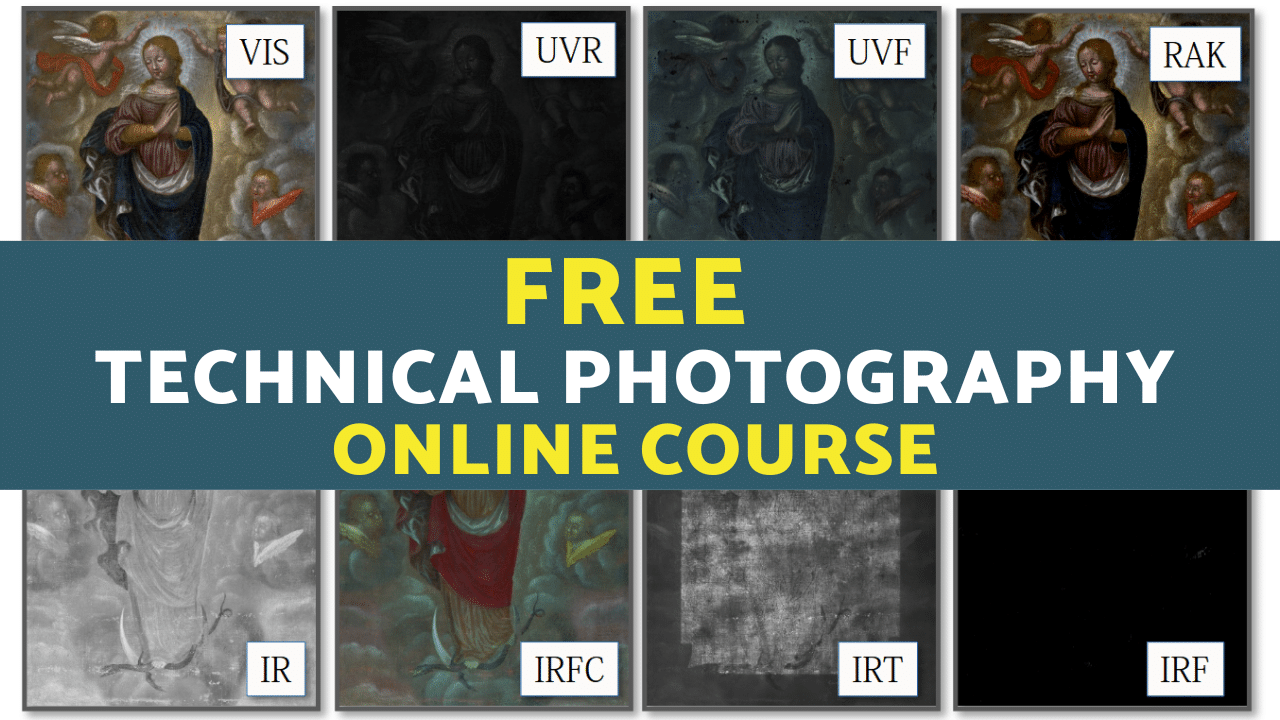
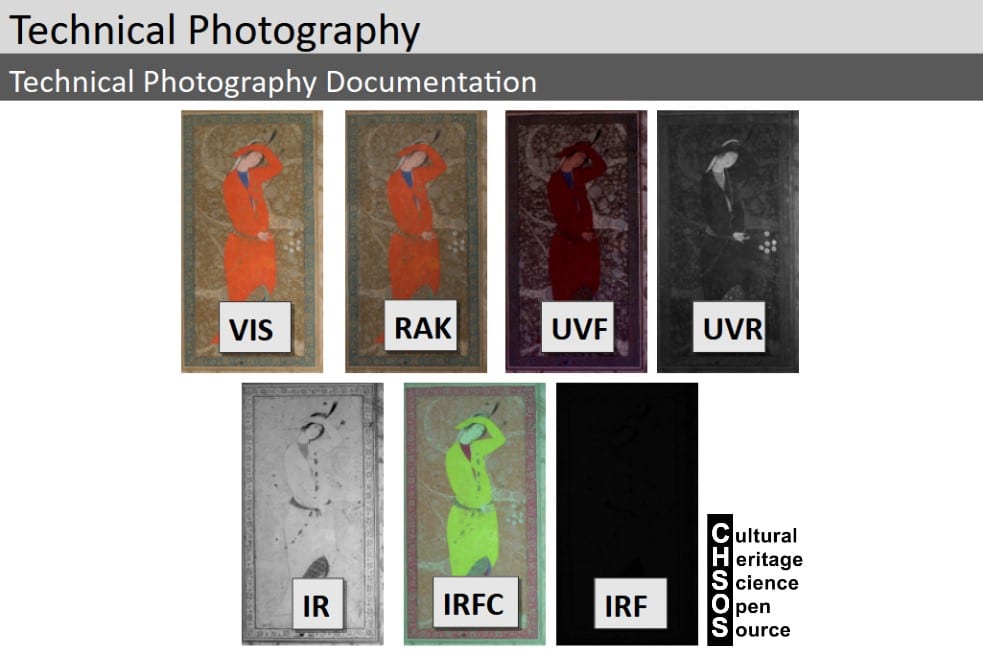
Technical Photography is one of the most powerful—and often overlooked—tools for the scientific examination of art and archaeology. If you are a conservator, scientist, or art collector and you are not yet familiar with this method, it is truly a missed opportunity. Using simple, affordable equipment and a clear methodology, Technical Photography allows you to reveal underdrawings, retouchings, material differences, and conservation issues in a completely non-invasive way. Far from being complex or inaccessible, it is an easy entry point into scientific analysis. In many cases, Technical Photography represents the first essential step toward a deeper understanding of artworks and archaeological objects.
Scientific Art Examination – Resources:
Getty Conservation Institute (GCI) – USA
The British Museum – Scientific Research Department – UK
Scientific Research Department – The Metropolitan Museum of Art, New York, USA
C2RMF (Centre de Recherche et de Restauration des Musées de France) – France
Rijksmuseum – Science Department – Netherlands