Home » Case Studies » 17th century Umbrian School Madonna and Child
17th century Umbrian School Madonna and Child
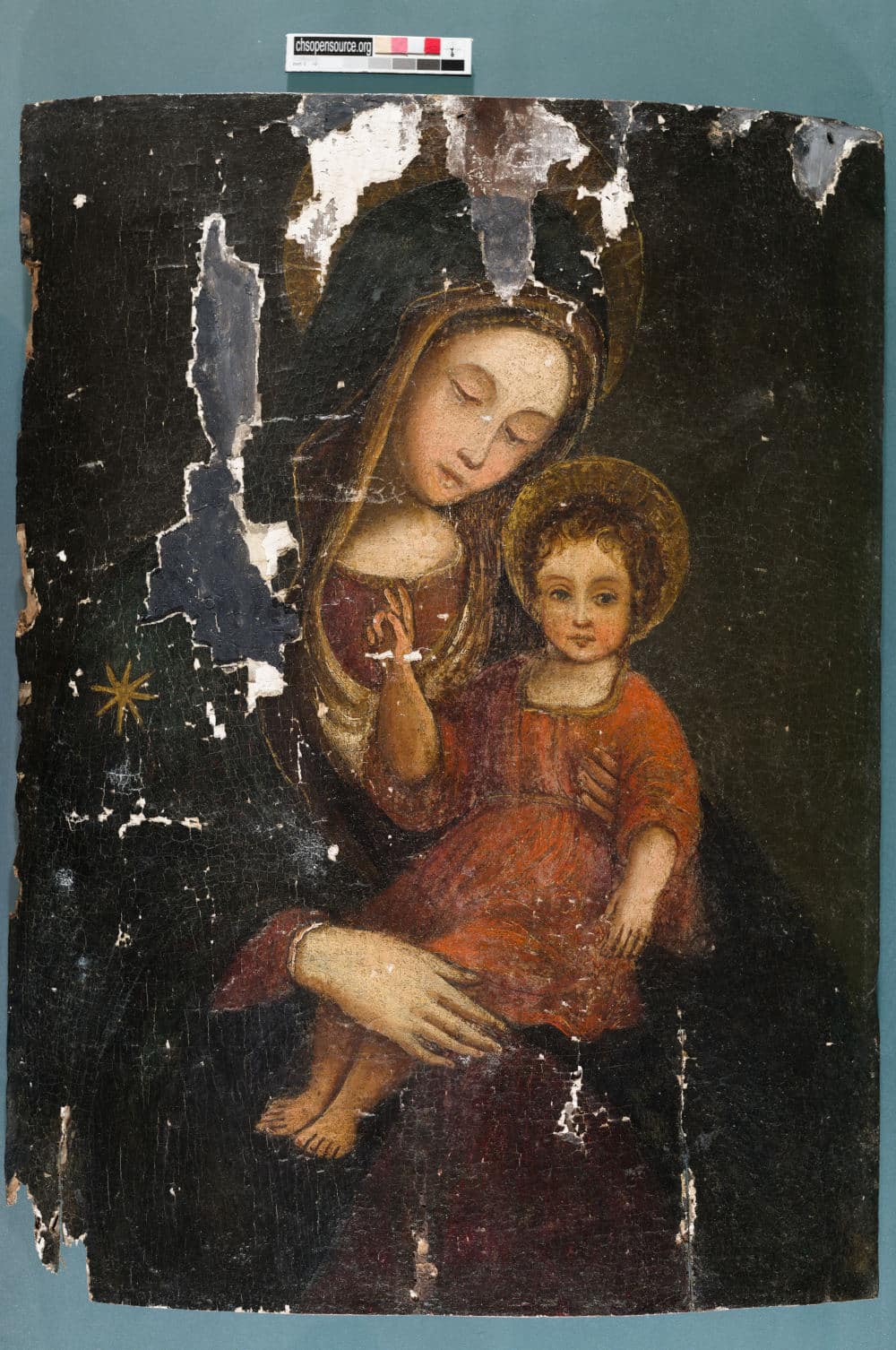
This is a devotional panel painting depicting the Virgin Mary with the Christ Child, likely dating to the 16th-17th centtury Umbrian school.
Mary is shown half-length, gently inclined toward the Child, her expression soft and introspective. Her lowered eyes and delicate features convey tenderness and humility.
The Christ Child sits on her arm, facing the viewer. He raises one hand in a gesture of blessing, while the other rests naturally by his side.
Both figures wear golden halos, rendered with simple circular forms rather than elaborate punchwork, suggesting a modest workshop or provincial context.
The background is dark and plain, originally intended to heighten the spiritual focus on the figures. Small remnants of decorative elements—such as the gold star on the left—hint at a once richer symbolic setting.
The painting is in poor condition, with extensive paint loss, flaking, abrasions, and areas where the ground layer is exposed. The surface shows widespread cracking and losses, especially in the background and along the edges.
The simplified modeling, warm earth tones, and frontal composition suggest a work intended for private devotion rather than public display.
The overall style bridges Byzantine icon tradition (hieratic pose, gold halos) and Western naturalism (soft facial modeling, childlike proportions).
Even in its damaged state, the painting retains a strong sense of intimacy and devotional purpose, offering insight into everyday religious imagery rather than courtly or monumental art.
CHSOS Collection – item #24
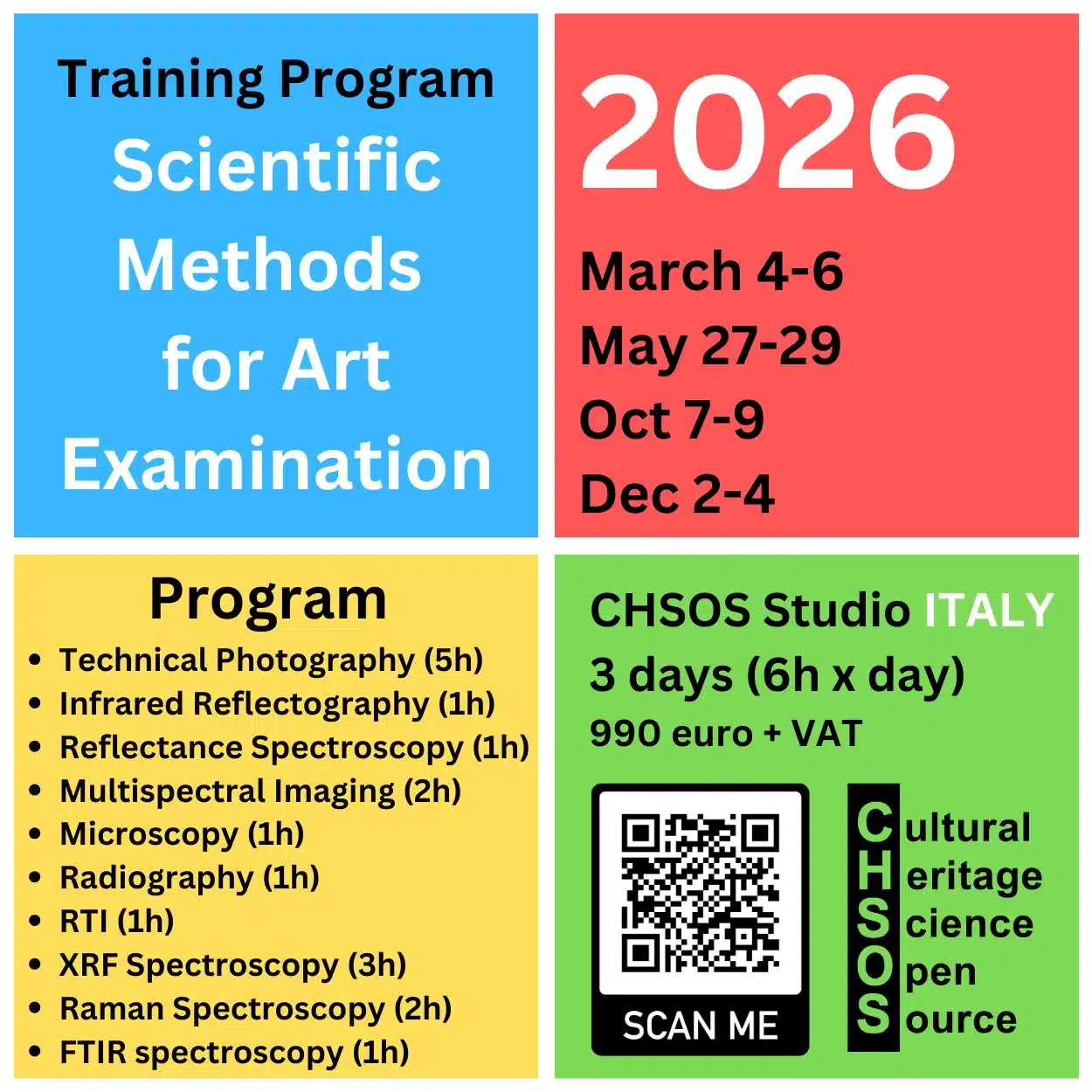
Training: Scientific Methods for Art Examination (December 2025)
This item was analyzed as a case study during the 3-day Training Program on the Scientific Methods for Art Examination hold in December 2025. I would like to thank the participants, Nicole, painting conservator based in Miami and Irwin, radiographer from New York, for conducting the examination and for sharing their expertise while practicing the scientific analysis methods.
Registration open for the Next Training Program!
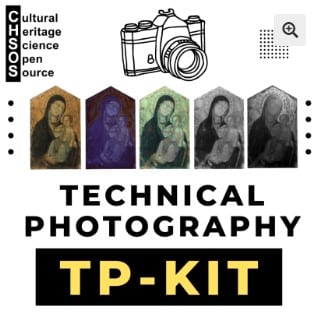
Technical Photography
The most revealing technique for this item is Transmitted Infrared (IRT) imaging. Part of the manuscript text is obscured by the miniature painting. While standard Infrared (IR) photography does not penetrate the paint layers enough to show the writing beneath, the IRT image successfully enhances the visibility of the hidden text, as expected.

XRF Spectroscopy
Among the colors analyzed, the most interesting was the white used in the sky. The XRF spectrum shows the presence of barium, titanium, and zinc, suggesting that the white color is a mixture of the most common late-19th-century whites: barium sulfate, titanium white, and zinc white. This combination was typical of the period, when manufacturers were seeking safer alternatives to toxic lead white. Color producers experimented with blends of established substitutes such as zinc white and barium sulfate, together with the newly introduced titanium white, which had not yet become a fully standardized pigment and was therefore often used in mixtures with the older whites.
Another interesting finding is that the golden frame decoration contains copper and zinc, in the proportion typical of modern brass.