
Home » Case Studies » Case study #001. 18th century Map of Jerusalem (35,5 x 46 cm). Hand-colored.
18th century Map of Jerusalem (35,5 x 46 cm). Hand-colored
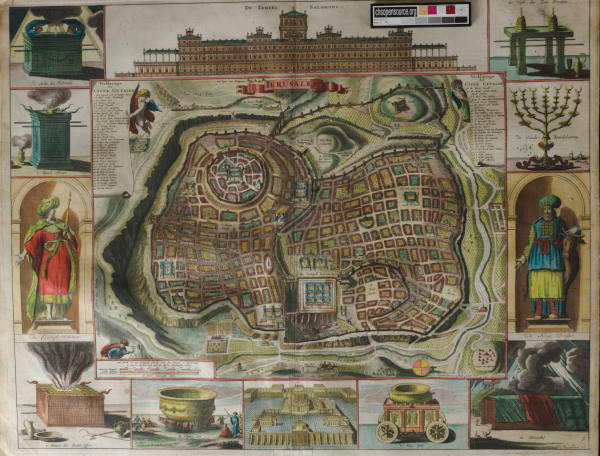
This richly colored 18th century Map of Jerusalem presents an imaginative reconstruction of the ancient town and the Temple of Solomon, blending topographical detail, biblical symbolism, and artistic interpretation. Published in “BIBLIA, Dat is, de gantsche Heylige Schrifture, […] Door last der Hoogh-Mog. Heeren Staten Generael…” (Dordrecht: Hendrick & Jacob Keur; Amsterdam: Marcus Doornick and Pieter Rotterdam, Anno 1702), it reflects the early 18th century’s fascination with sacred geography and the visualization of the Holy City.
At its center lies a bird’s-eye view of Jerusalem, enclosed by walls and organized in a highly schematic form that merges biblical narrative with Renaissance and Baroque cartographic conventions. The Temple of Solomon dominates the composition, rendered with elaborate architectural precision reminiscent of contemporary European palaces rather than ancient structures.
Surrounding the city are detailed vignettes illustrating sacred objects and figures: the Ark of the Covenant, the Menorah, the Brazen Altar, the Molten Sea, and priestly and royal figures such as King Solomon and the High Priest. Each element serves a didactic and devotional purpose—transforming the map into a visual theology of divine order and worship.
CHSOS Collection – item #1.
Technical Photography
The power of technical photography lies in the sheer number of images captured: while many may not reveal much, some often uncover fascinating details. In this case study, the IRF-UV image proves the most revealing. It shows that the red borders of this hand-colored print map of Jerusalem exhibit infrared fluorescence under UV lamp illumination, suggesting the use of the modern cadmium red pigment.

Learn Technical Photography for Art Examination
Technical Photography is one of the most powerful—and often overlooked—tools for the scientific examination of art and archaeology. If you are a conservator, scientist, or art collector and you are not yet familiar with this method, it is truly a missed opportunity. Using simple, affordable equipment and a clear methodology, Technical Photography allows you to reveal underdrawings, retouchings, material differences, and conservation issues in a completely non-invasive way. Far from being complex or inaccessible, it is an easy entry point into scientific analysis. In many cases, Technical Photography represents the first essential step toward a deeper understanding of artworks and archaeological objects.
Scientific Art Examination – Resources:
Getty Conservation Institute (GCI) – USA
The British Museum – Scientific Research Department – UK
Scientific Research Department – The Metropolitan Museum of Art, New York, USA
C2RMF (Centre de Recherche et de Restauration des Musées de France) – France
Rijksmuseum – Science Department – Netherlands