The first real violet pigment prepared in 1859. Its high cost and low tinting power prevented its wider use in painting and it was replaced by the cleaner manganese violet.
Manufacturer / product code: Kremer / 45800
Chemical description: cobalt phosphate
Color: violet
Color Index: PV14
More info: Pigments Through The Ages Colourlex
Cobalt violet is one of the earliest synthetic violet pigments, introduced in the second half of the 19th century as artists sought stable alternatives to the fugitive organic violets then in use. Produced from cobalt salts combined with phosphates or arsenates (the earliest versions contained cobalt arsenate), it offered a softly luminous, slightly granulating purple unlike any natural pigment available at the time. Its delicate, cool hue quickly attracted painters of the Impressionist and Post-Impressionist periods, who valued its ability to create atmospheric shadows, floral tones, and subtle transitions in skies and landscapes.
In art, cobalt violet is appreciated for its gentle transparency, low tinting strength, and unique pastel clarity. These characteristics make it ideal for glazing, optical mixing, and building soft chromatic layers without overwhelming adjacent colours. Modern formulations avoid the toxic arsenate compounds, relying instead on cobalt phosphate chemistry, which preserves the pigment’s characteristic softness while improving safety. Highly lightfast and chemically stable, cobalt violet remains a refined choice for artists seeking a nuanced, permanent violet with a poetic, understated presence.
Raman Spectroscopy 532 nm – ElviRa Spectrometer for Art
Raman Spectroscopy 532 nm (ElviRa spectrometer) Pigments-Checker Database (84719 downloads )

Raman Spectroscopy 632 nm – ElviRa Spectrometer for Art

Raman spectroscopy 785 nm
Pigments (powder, no binder)

Raman Spectroscopy 785 nm Pigments (pure, no binder) (86307 downloads )
Pigments with acrylic binder (Pigments Checker)

Raman Spectroscopy 785 nm Pigments-Checker Database (87502 downloads )
Pure pigments (no binder, just powder)
DOWNLOAD paper: “Pigments Checker version 3.0, a handy set for conservation scientists: A free online Raman spectra database”

Raman spectroscopy 830 nm
Pigments (powder, no binder)

Raman Spectroscopy 830 nm Pigments-Checker Database (70717 downloads )
XRF spectroscopy
XRF Spectroscopy Pigments-Checker Database (102491 downloads )
DOWNLOAD previous database from Pigments Checker V.3 DOWNLOAD paper: R. Larsen, N. Coluzzi, A. Cosentino “Free XRF Spectroscopy database of Pigments Checker” Intl Journal of Conservation Science.

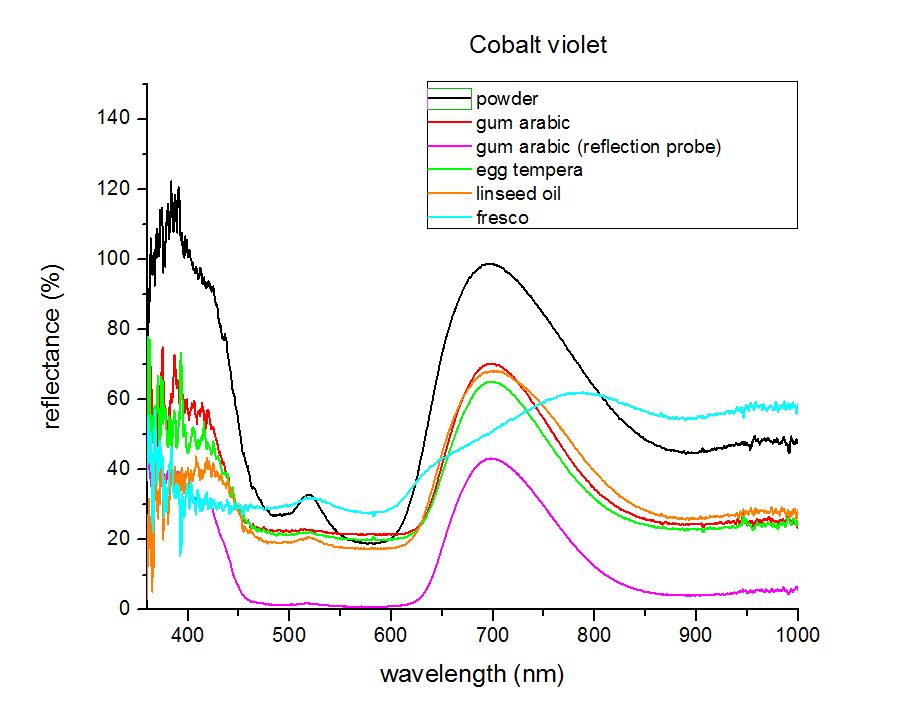
Reflectance Spectroscopy (200-1000 nm) – GorgiasUV Spectrometer
Reflectance Spectroscopy (200-1000 nm) (GorgiasUV) Pigments-Checker Database (105243 downloads )

Reflectance spectroscopy – Gorgias Spectrometer for Art

NIR Reflectance spectroscopy
NIR-Reflectance Spectroscopy (930-1690 nm) Pigments-Checker Database (99664 downloads )

FT-IR Spectroscopy (Non-invasive Diffuse Reflectance Probe)

FTIR Diffuse Reflectance Spectroscopy Pigments-Checker Database (88378 downloads )

FTIR non-invasive Spectroscopy Pigments (pure, no binder) Database (91252 downloads )