Unboxing and Mounting the Archimedes Scanner
Welcome to the first step in your Archimedes scanner journey! In this lesson we walk you through unboxing your scanner components and assembling the system for the first time. The Archimedes scanner arrives carefully packaged with all the mechanical parts, electronics, cameras, cables, and accessories you need to begin capturing high-quality scans.
Start by laying out all components on a clean, flat surface and checking them against the included parts list. You’ll find the main frame, turntable, camera mount assemblies, lighting arms, control box, power supply, and fasteners. Take a moment to familiarize yourself with each piece — this will make assembly smoother and faster.
Our step-by-step instructions guide you through attaching the frame supports, securing the cameras and lighting bars, and connecting the turntable and control electronics. Along the way we include helpful tips for tightening fasteners, aligning the camera mounts correctly, and routing cables neatly to keep your workspace organized.
Once everything is assembled, we walk you through mounting the scanner to your workbench or tripod — ensuring stability and optimal scanning geometry. When complete, you’ll be ready to connect the unit to your computer and begin installing the scanner software in the next lesson.
Hardware and Software Installation
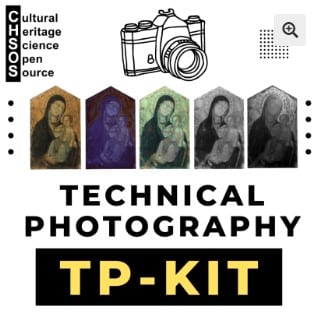
Learn Technical Photography for Art Examination
Technical Photography is one of the most powerful—and often overlooked—tools for the scientific examination of art and archaeology. If you are a conservator, scientist, or art collector and you are not yet familiar with this method, it is truly a missed opportunity. Using simple, affordable equipment and a clear methodology, Technical Photography allows you to reveal underdrawings, retouchings, material differences, and conservation issues in a completely non-invasive way. Far from being complex or inaccessible, it is an easy entry point into scientific analysis. In many cases, Technical Photography represents the first essential step toward a deeper understanding of artworks and archaeological objects.
Scientific Art Examination – Resources:
Getty Conservation Institute (GCI) – USA
The British Museum – Scientific Research Department – UK
Scientific Research Department – The Metropolitan Museum of Art, New York, USA
C2RMF (Centre de Recherche et de Restauration des Musées de France) – France
Rijksmuseum – Science Department – Netherlands