- Understand the principles of multispectral imaging.
- Learn how to use spectral filters to isolate carbon-based ink.
- Explore the process of building a multispectral cube for enhanced image analysis.
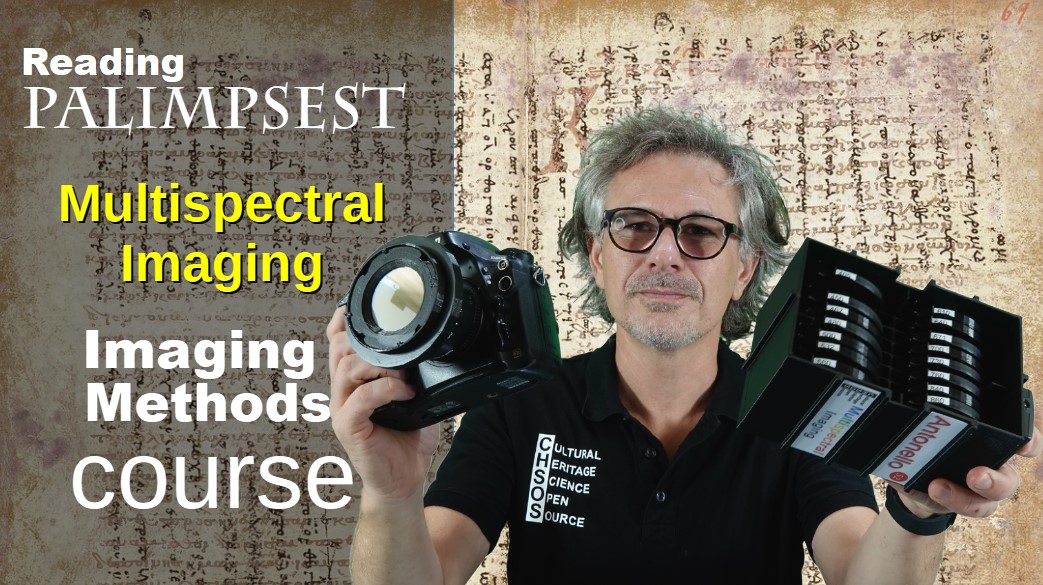
- Antonello, multispectral imaging system with 18 spectral filters.
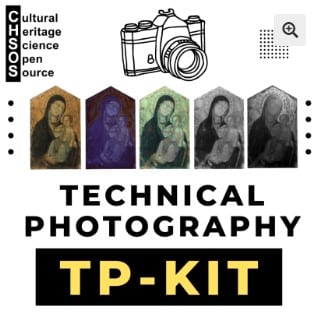
- Modified digital camera for Technical Photography.
- Mock-up palimpsest.
- Introduction to Multispectral Imaging
- Explanation of Antonello multispectral imaging system.
- Review of reflectance spectra for support, iron gall ink, and carbon black ink.
- Filter Selection
- Selection of three key filters based on reflectance spectra (450 nm, 671 nm, and 920 nm).
- Building the Multispectral Cube
- Demonstration of loading spectral images into the software.
- Step-by-step process for selecting carbon ink points and applying classification algorithms.
- Image Classification and Enhancement
- Using Euclidean distance to classify carbon ink.
- Adjusting tolerance to optimize visibility of the faded text.


Learn Multispectral Imaging
Multispectral imaging is a powerful extension of Technical Photography and a key step toward advanced scientific examination of art and archaeology. With the Antonello system, this approach becomes accessible, structured, and affordable, even for those without a strong technical background. If you are a conservator, scientist, or art collector and you are not yet using multispectral imaging, you are missing a valuable source of information. By capturing images under selected wavelength bands, the Antonello system helps reveal material differences, pigment distributions, and hidden features in a fully non-invasive way. Multispectral imaging with Antonello offers a practical and reliable starting point for evidence-based art analysis.


Scientific Art Examination – Resources:
Getty Conservation Institute (GCI) – USA
The British Museum – Scientific Research Department – UK
Scientific Research Department – The Metropolitan Museum of Art, New York, USA
C2RMF (Centre de Recherche et de Restauration des Musées de France) – France
Rijksmuseum – Science Department – Netherlands