Stand for Works on Paper — Elvira Spectrometer
In this lesson we introduce the stand designed specifically for works on paper, an essential accessory for stable and accurate spectral imaging with the Elvira Spectrometer. When analyzing delicate or flat paper-based materials — such as manuscripts, prints, maps, or artworks — having a reliable, adjustable stand ensures consistent positioning, minimizes vibrations, and supports reproducible results.
The stand provides a solid platform that holds the Elvira Spectrometer at an optimal distance and angle from the paper surface. Its adjustable height and tilt mechanisms let you tailor the setup to the size and thickness of the work, while keeping the optical axis perpendicular to the sample. This alignment is crucial for achieving uniform illumination and maximizing spectral fidelity across the entire scanned area.
We walk you through assembling the stand components, securing the spectrometer, and adjusting the platform to accommodate different paper sizes. You’ll also learn best practices for placing and securing fragile documents without causing stress or damage. With clear guidance on adjusting focus, lighting, and sample orientation, this lesson ensures you can work confidently with a wide range of paper-based materials.
By the end of this lesson you’ll understand how to set up and use the stand to support precise, stable, and non-invasive spectral imaging of works on paper using the Elvira Spectrometer.
Step-by-step mounting instructions.
How to use it.
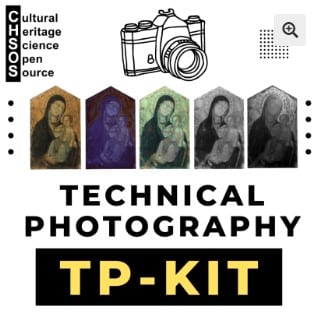
Learn Technical Photography for Art Examination
Technical Photography is one of the most powerful—and often overlooked—tools for the scientific examination of art and archaeology. If you are a conservator, scientist, or art collector and you are not yet familiar with this method, it is truly a missed opportunity. Using simple, affordable equipment and a clear methodology, Technical Photography allows you to reveal underdrawings, retouchings, material differences, and conservation issues in a completely non-invasive way. Far from being complex or inaccessible, it is an easy entry point into scientific analysis. In many cases, Technical Photography represents the first essential step toward a deeper understanding of artworks and archaeological objects.
Scientific Art Examination – Resources:
Getty Conservation Institute (GCI) – USA
The British Museum – Scientific Research Department – UK
Scientific Research Department – The Metropolitan Museum of Art, New York, USA
C2RMF (Centre de Recherche et de Restauration des Musées de France) – France
Rijksmuseum – Science Department – Netherlands