Infrared Reflectography

Course - Reading Palimpsests - infrared reflectography
This lesson delves into the use of infrared reflectography as an effective tool for enhancing the readability of palimpsests. In particular, this technique proves invaluable when examining texts overwritten with iron gall ink, which becomes transparent in the far-infrared spectral range. This transparency allows for easier reading of underlying carbon-based inks, making it a powerful method for revealing hidden or obscured writings. Course - Reading Palimpsests - infrared reflectography Course - Reading Palimpsests - infrared reflectography Course - Reading Palimpsests - infrared reflectography  

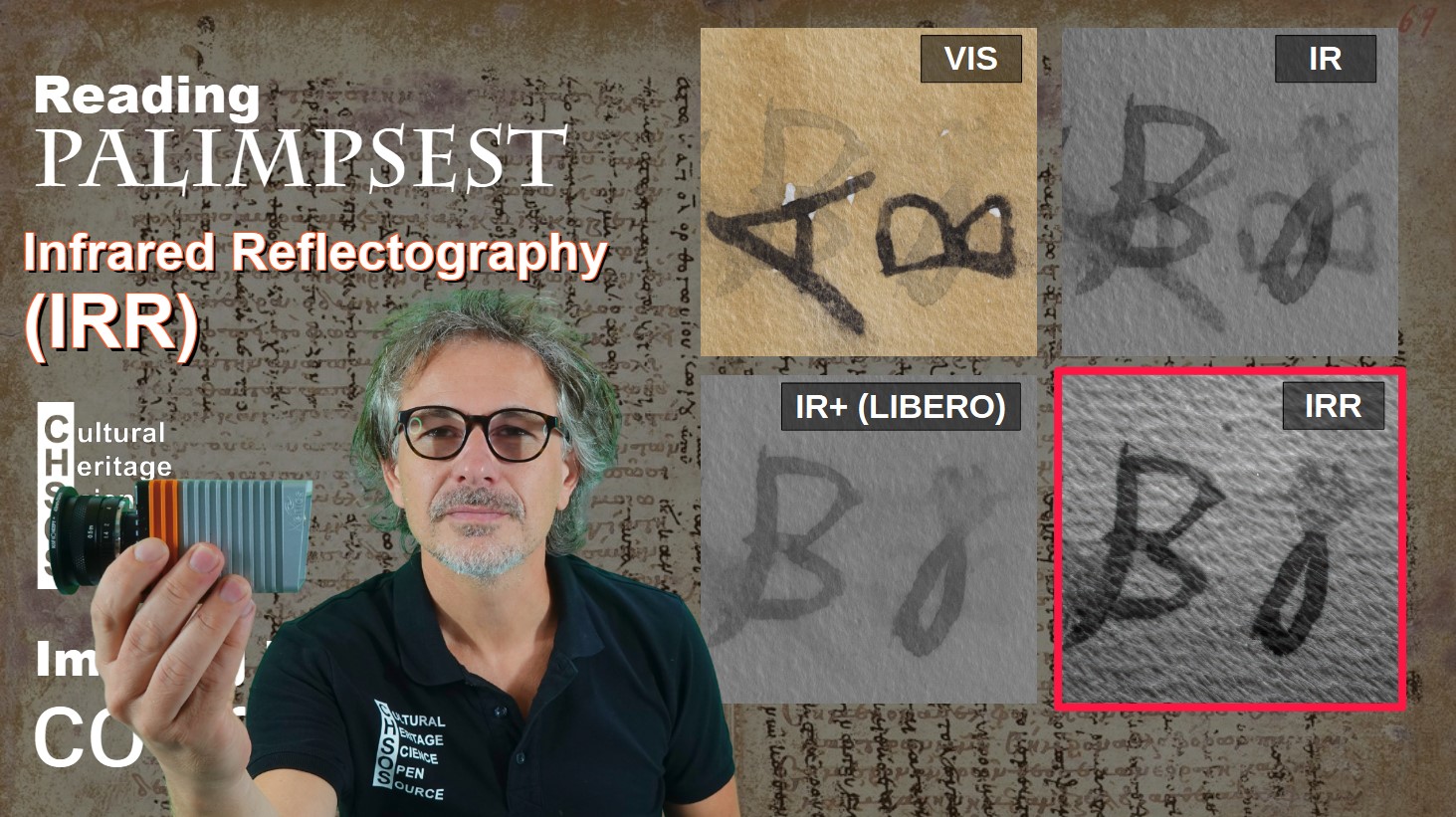
In this class, we explore Infrared Reflectography (IRR), an imaging method that is particularly useful for the examination of palimpsests. Infrared Reflectography for reading palimpsests allows us to compare visible images, near-infrared images acquired with technical photography, and true infrared reflectography images in order to evaluate their effectiveness in revealing erased or overwritten texts.

We have already discussed technical photography in a previous lesson. Using a modified digital camera and an IR+ filter (LIBERO), it is possible to record the furthest part of the infrared spectrum accessible to silicon sensors, approximately 1050–1100 nm. This already improves the transparency of iron gall ink compared to visible light, but it does not reach the full potential of infrared imaging.

The focus of this lesson is infrared reflectography, which operates beyond the limits of standard digital cameras. Dedicated scientific cameras allow access to the 1100–1700 nm spectral range. The most commonly used sensors in art examination are InGaAs cameras, named after indium, gallium, and arsenic. Infrared Reflectography for reading palimpsests is especially effective because most pigments, including iron gall ink, become increasingly transparent at longer infrared wavelengths.

This behavior is confirmed by reflectance spectroscopy, which shows that iron gall ink reaches maximum transparency around 1400 nm. This explains why infrared reflectography can almost completely remove the visibility of iron gall ink, revealing the underlying text far more effectively than IR+ imaging. For this reason, Infrared Reflectography for reading palimpsests represents the most powerful imaging solution when maximum ink suppression is required, despite its higher cost and lower spatial resolution compared to standard technical photography.

To reinforce the concepts discussed here, we also provide a video lesson that visually walks through the key points of this topic. Watching the video alongside the text can help you better understand and apply these ideas in practice.


Training 2026

Scientific Art Examination – Resources:
Getty Conservation Institute (GCI) – USA
The British Museum – Scientific Research Department – UK
Scientific Research Department – The Metropolitan Museum of Art, New York, USA
C2RMF (Centre de Recherche et de Restauration des Musées de France) – France
Rijksmuseum – Science Department – Netherlands