LIBERO (IR+) Filter

Course - Reading Palimpsests - IR+ LIBERO
This lesson explores our IR+ filter, LIBERO. This is a special infrared filter that enhances the infrared vision of the technical photography camera. This filter just selects the furthest part of the infrared spectrum that a modified camera can detect. In this region, the iron gall ink becomes much more transparent and can be almost totally removed from the image. Course - Reading Palimpsests - IR+ LIBERO Course - Reading Palimpsests - IR+ LIBERO
Libero

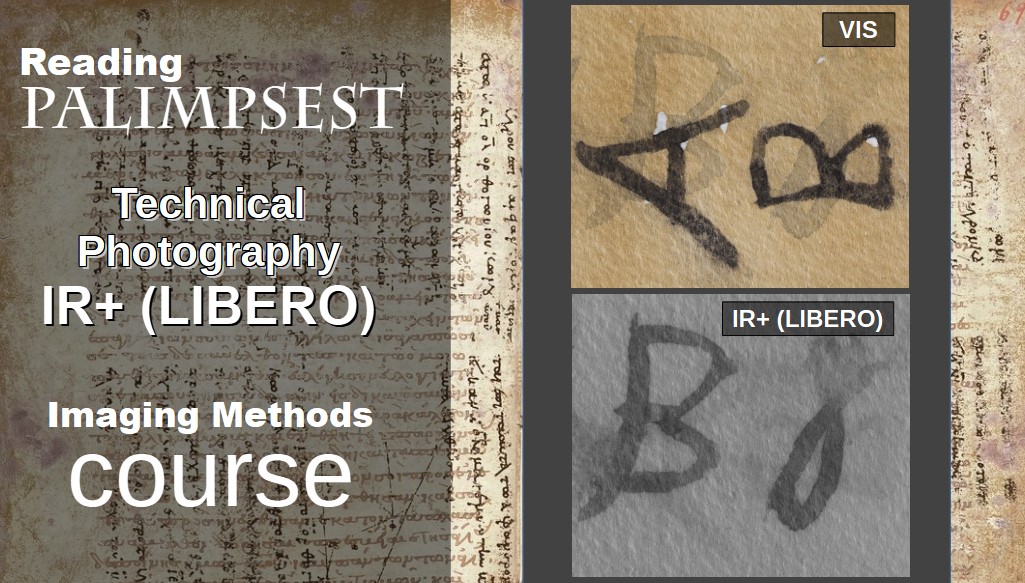
In this class, we introduce the use of the IR+ filter, called LIBERO, a new product developed specifically for advanced technical photography. The LIBERO (IR+) Filter for palimpsests is designed to isolate the furthest infrared wavelengths detectable by a modified digital camera, maximizing ink transparency while preserving image usability. Our goal is to test its performance on palimpsests using a dedicated mock-up.

We begin with a standard visible-light image showing two Latin letters, A and B, written in iron gall ink, with faint Greek letters, Beta and Gamma, beneath them. The Greek text is written with carbon-based ink, typical of antiquity. When using a standard infrared filter, the iron gall ink becomes only slightly transparent, offering limited improvement in readability. By contrast, applying the LIBERO (IR+) Filter for palimpsests produces a much higher contrast image in which the iron gall ink almost completely disappears and the underlying Greek letters become clearly legible.

This result is explained by the filter’s transmittance curve. LIBERO blocks all visible light and most near-infrared radiation, transmitting primarily wavelengths above 1050 nm, with maximum transmittance near 1100 nm, which corresponds to the upper sensitivity limit of silicon sensors. By working exclusively in this narrow spectral window, inks and pigments exhibit increased transparency.

During the live acquisition, we replace the visible and standard IR filters with the IR+ filter, increase exposure time due to lower sensor sensitivity, and illuminate the scene with halogen lamps. The resulting image demonstrates how the LIBERO (IR+) Filter for palimpsests enables rapid and effective reading of overwritten texts after simple black-and-white processing.

To reinforce the concepts discussed here, we also provide a video lesson that visually walks through the key points of this topic. Watching the video alongside the text can help you better understand and apply these ideas in practice.


Training 2026

Scientific Art Examination – Resources:
Getty Conservation Institute (GCI) – USA
The British Museum – Scientific Research Department – UK
Scientific Research Department – The Metropolitan Museum of Art, New York, USA
C2RMF (Centre de Recherche et de Restauration des Musées de France) – France
Rijksmuseum – Science Department – Netherlands