Reflectance Spectroscopy

Course - Reading Palimpsests - reflectance spectroscopy

This lesson explores Reflectance Spectroscopy for palimpsests analysis and its foundational methods for setting up an imaging strategy.

Course - Reading Palimpsests - reflectance spectroscopy

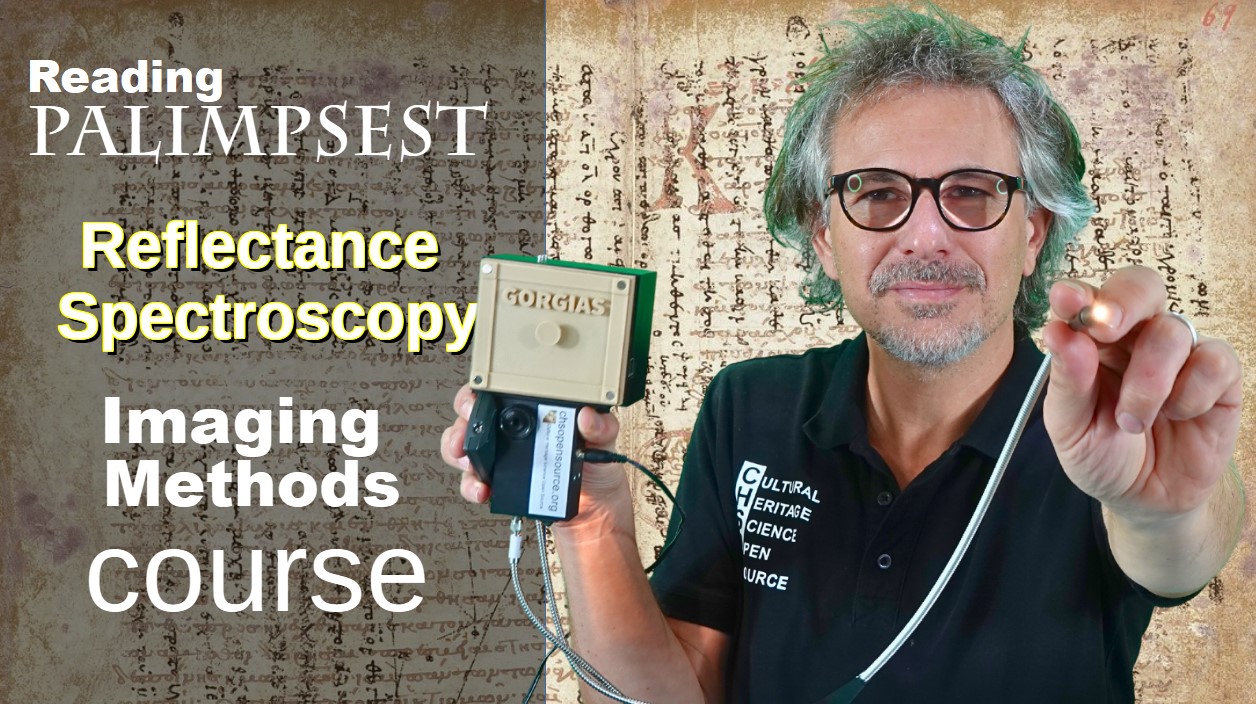
This course focuses on reading palimpsests using imaging methods. Our goal is to move from a visually obscured text to a readable one through multispectral imaging. To do this effectively, we must implement reflectance spectroscopy for palimpsests analysis.

Reflectance spectroscopy is the most affordable spectroscopic method available, and it plays a key role in planning a multispectral imaging examination. By analyzing reflectance spectra first, we can design an optimized imaging strategy instead of blindly using all the filters available in our system. In other words, we can select only the filters that are most likely to deliver meaningful results.

Reflectance spectroscopy is widely used for the examination of pigments, but in this case we apply it to a mock-up palimpsest. We measure the reflectance spectra of the support and of two different inks: iron gall ink and carbon ink. For those who are new to reflectance spectroscopy, our website offers a free online course explaining the principles of the method and the practical use of the GORGIAS reflectance spectrometer for art.

The software displays wavelength on the X-axis (from 350 to 1000 nm) and reflectance percentage on the Y-axis. Acquiring spectra is straightforward. The probe is gently placed on the surface at a 45-degree angle, keeping the same position and angle for all measurements. We first measure the support, then the iron gall ink, and finally the faint carbon ink.

The results show clear differences. Carbon ink absorbs strongly in the visible range and becomes more reflective in the infrared. Iron gall ink has very low reflectance in the visible, appearing black, and starts reflecting more in the infrared. The support shows a much higher reflectance across the spectrum.

When planning a multispectral imaging examination with the Antonello system, which includes 18 filters, it is common—especially for complex paintings—to use all filters to build a full multispectral cube. However, in this case the materials are spectrally simple. The reflectance spectra show that only three filters are needed: one in the visible region, one where the contrast between paper and iron gall ink is maximal, and one in the infrared where the contrast between paper and carbon ink is greatest.

These three filters capture the essential spectral features of the inks and the support. Using additional filters would not provide further useful information.

To reinforce the concepts discussed here, we also provide a video lesson that visually walks through the key points of this topic. Watching the video alongside the text can help you better understand and apply these ideas in practice.


Training 2026

Scientific Art Examination – Resources:
Getty Conservation Institute (GCI) – USA
The British Museum – Scientific Research Department – UK
Scientific Research Department – The Metropolitan Museum of Art, New York, USA
C2RMF (Centre de Recherche et de Restauration des Musées de France) – France
Rijksmuseum – Science Department – Netherlands