Chemical elements

This section brings together the collection of video lessons dedicated to the XRF spectroscopy of individual chemical elements commonly used in the production of pigments. These lessons are designed to bridge fundamental XRF principles with their practical application in the identification and study of pigment materials.

Each video focuses on a specific element, describing its characteristic X-ray emission lines and explaining how these features appear within an XRF spectrum. Attention is given to the most diagnostically relevant peaks, potential overlaps, and typical spectral patterns encountered when analyzing pigments and pigment-based materials.

The lessons also discuss the role of each element in historical and modern pigments, helping viewers connect spectral data with real-world materials. Where relevant, variations in composition, impurities, and elemental associations are highlighted, providing additional context for interpretation.

By examining elements one at a time, this collection offers a structured and methodical approach to learning elemental XRF analysis. It enables users to build confidence in reading spectra, recognizing key signatures, and understanding how elemental information supports pigment identification in art, archaeology, and conservation science.

XRF spectroscopy course sodium ALUMINUM - XRF Spectroscopy for Art Examination XRF Spectroscopy for Art Examination - ARGON XRF Spectroscopy for Art Examination - TITANIUM XRF Spectroscopy for Art Examination - CHROMIUM XRF Spectroscopy for Art Examination - MANGANESE XRF Spectroscopy for Art Examination - IRON XRF Spectroscopy for Art Examination - ZINC XRF Spectroscopy for Art Examination - ARSENIC XRF Spectroscopy for Art Examination - STRONTIUM XRF Spectroscopy for Art Examination - ZIRCONIUM XRF Spectroscopy for Art Examination - RHODIUM XRF Spectroscopy for Art Examination - ANTIMONY XRF Spectroscopy for Art Examination - IODINE XRF Spectroscopy for Art Examination - BARIUM XRF Spectroscopy for Art Examination - CERIUM XRF Spectroscopy for Art Examination - GOLD XRF Spectroscopy for Art Examination - MERCURY XRF Spectroscopy for Art Examination - BISMUTH

To reinforce the concepts discussed here, we also provide a video lesson that visually walks through the key points of this topic. Watching the video alongside the text can help you better understand and apply these ideas in practice.

XRF Spectroscopy for Art Examination

The course XRF Spectroscopy for Art Examination introduces conservators, art historians, and scientists with interest in Art to the principles and practical applications of X-ray fluorescence (XRF) spectroscopy in the examination of artworks. The course starts with basic principles of XRF and gradually explores its role in identifying materials and methods used in the creation and conservation of art.

Course Objectives

  • Understand the fundamentals of XRF spectroscopy and how it applies to the analysis of art.
  • Learn the key features and limitations of XRF for examining art and archaeology.
  • Gain skills in interpreting XRF spectra to identify specific elements in paint layers, inks and metals.

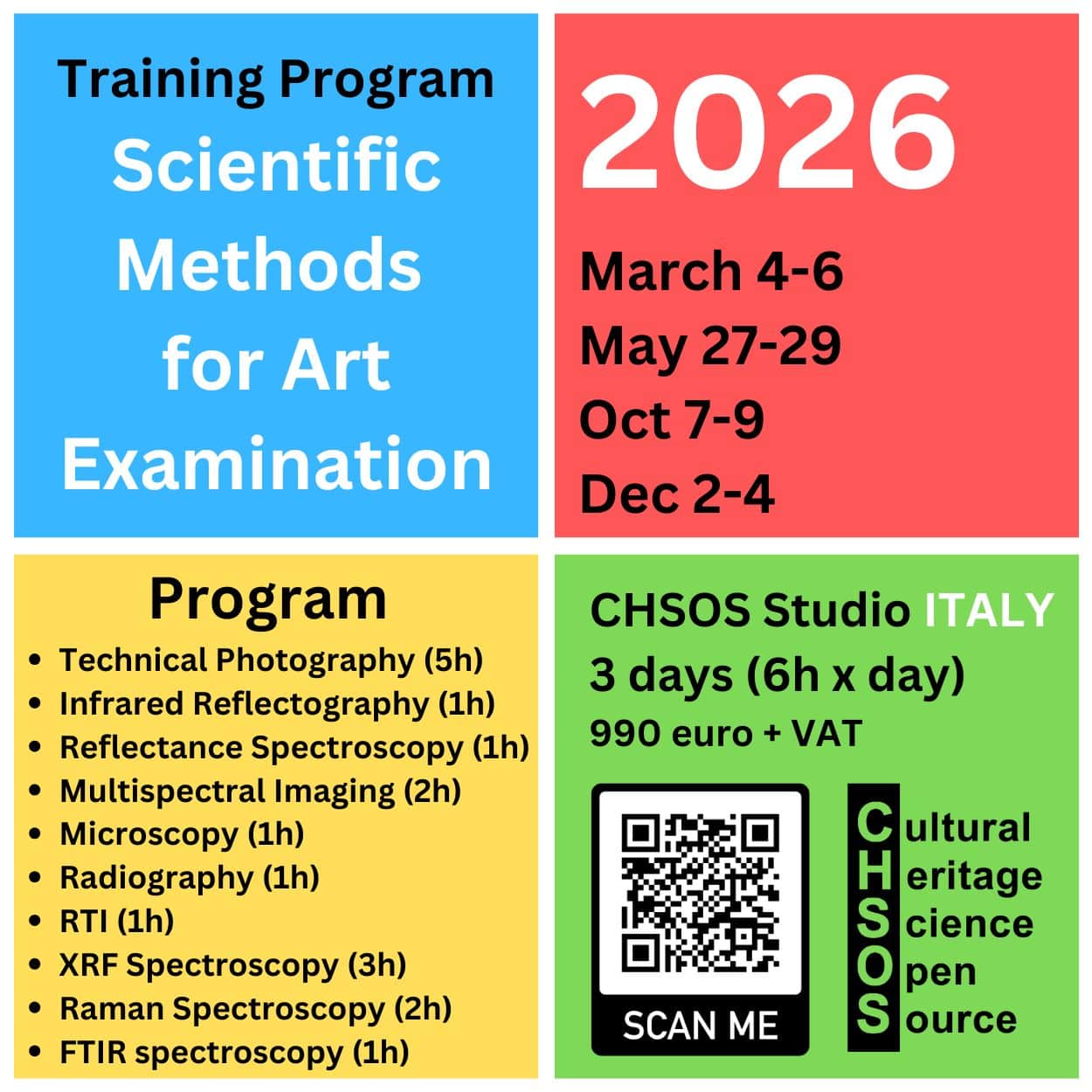
Training 2026

Scientific Art Examination – Resources:
Getty Conservation Institute (GCI) – USA
The British Museum – Scientific Research Department – UK
Scientific Research Department – The Metropolitan Museum of Art, New York, USA
C2RMF (Centre de Recherche et de Restauration des Musées de France) – France
Rijksmuseum – Science Department – Netherlands