The X-ray tube

This section includes a series of video lessons specifically created to introduce the X-ray tube used in an XRF spectroscopy system. The videos provide a clear explanation of how the tube works and why its configuration is critical for obtaining reliable and meaningful analytical results.

The lessons first address the concept of X-ray output, explaining how voltage, current, and spectral distribution influence excitation conditions. Special attention is given to the role of filters, illustrating how they modify the emitted spectrum to optimize sensitivity and reduce background noise.

Different operational setups are then discussed in detail, including the no-filter configuration, commonly used for general surveys, as well as routine and low-keV filter setups designed to enhance the detection of specific elemental ranges. Each configuration is presented with its practical applications and limitations, helping users understand when and why to select a particular setup.

Finally, the lessons focus on rhodium, the material used as the target of the X-ray tube in this system. The characteristic emission lines of rhodium and their impact on excitation efficiency are explained, providing essential context for interpreting XRF spectra and making informed instrumental choices.

To reinforce the concepts discussed here, we also provide a video lesson that visually walks through the key points of this topic. Watching the video alongside the text can help you better understand and apply these ideas in practice.

XRF Spectroscopy for Art Examination

The course XRF Spectroscopy for Art Examination introduces conservators, art historians, and scientists with interest in Art to the principles and practical applications of X-ray fluorescence (XRF) spectroscopy in the examination of artworks. The course starts with basic principles of XRF and gradually explores its role in identifying materials and methods used in the creation and conservation of art.

Course Objectives

  • Understand the fundamentals of XRF spectroscopy and how it applies to the analysis of art.
  • Learn the key features and limitations of XRF for examining art and archaeology.
  • Gain skills in interpreting XRF spectra to identify specific elements in paint layers, inks and metals.

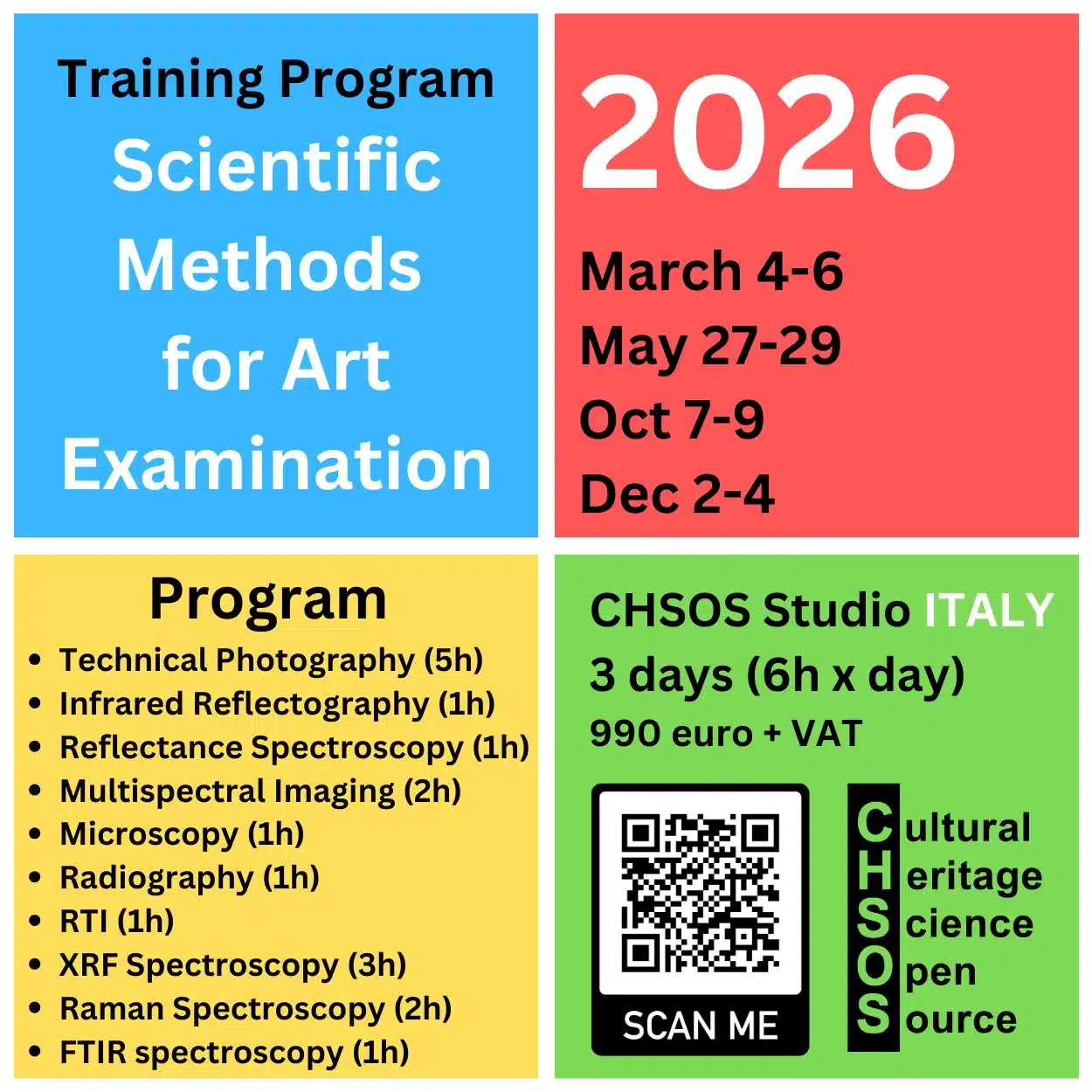
Training 2026

Scientific Art Examination – Resources:
Getty Conservation Institute (GCI) – USA
The British Museum – Scientific Research Department – UK
Scientific Research Department – The Metropolitan Museum of Art, New York, USA
C2RMF (Centre de Recherche et de Restauration des Musées de France) – France
Rijksmuseum – Science Department – Netherlands