X-ray absorption calculator

X-ray absorption calculator

This video demonstrates how to use this tool. While showcased here for the sodium lesson, it can be tested with many materials beyond air.


X-ray absorption in matter describes how the intensity of an X-ray beam is reduced as photons interact with a material. In addition to true absorption, where inner-shell electrons are ejected once the photon energy exceeds their binding energy, scattering processes also contribute to beam attenuation. Elastic (Rayleigh) and inelastic (Compton) scattering redirect photons away from the primary beam, effectively lowering its transmitted intensity. The overall attenuation depends on photon energy, elemental composition, density, and thickness of the material. The online X-ray absorption calculator presented on this page accounts for these effects and displays absorption and transmission results as clear percentages.

To reinforce the concepts discussed here, we also provide a video lesson that visually walks through the key points of this topic. Watching the video alongside the text can help you better understand and apply these ideas in practice.

XRF Spectroscopy for Art Examination

The course XRF Spectroscopy for Art Examination introduces conservators, art historians, and scientists with interest in Art to the principles and practical applications of X-ray fluorescence (XRF) spectroscopy in the examination of artworks. The course starts with basic principles of XRF and gradually explores its role in identifying materials and methods used in the creation and conservation of art.

Course Objectives

  • Understand the fundamentals of XRF spectroscopy and how it applies to the analysis of art.
  • Learn the key features and limitations of XRF for examining art and archaeology.
  • Gain skills in interpreting XRF spectra to identify specific elements in paint layers, inks and metals.

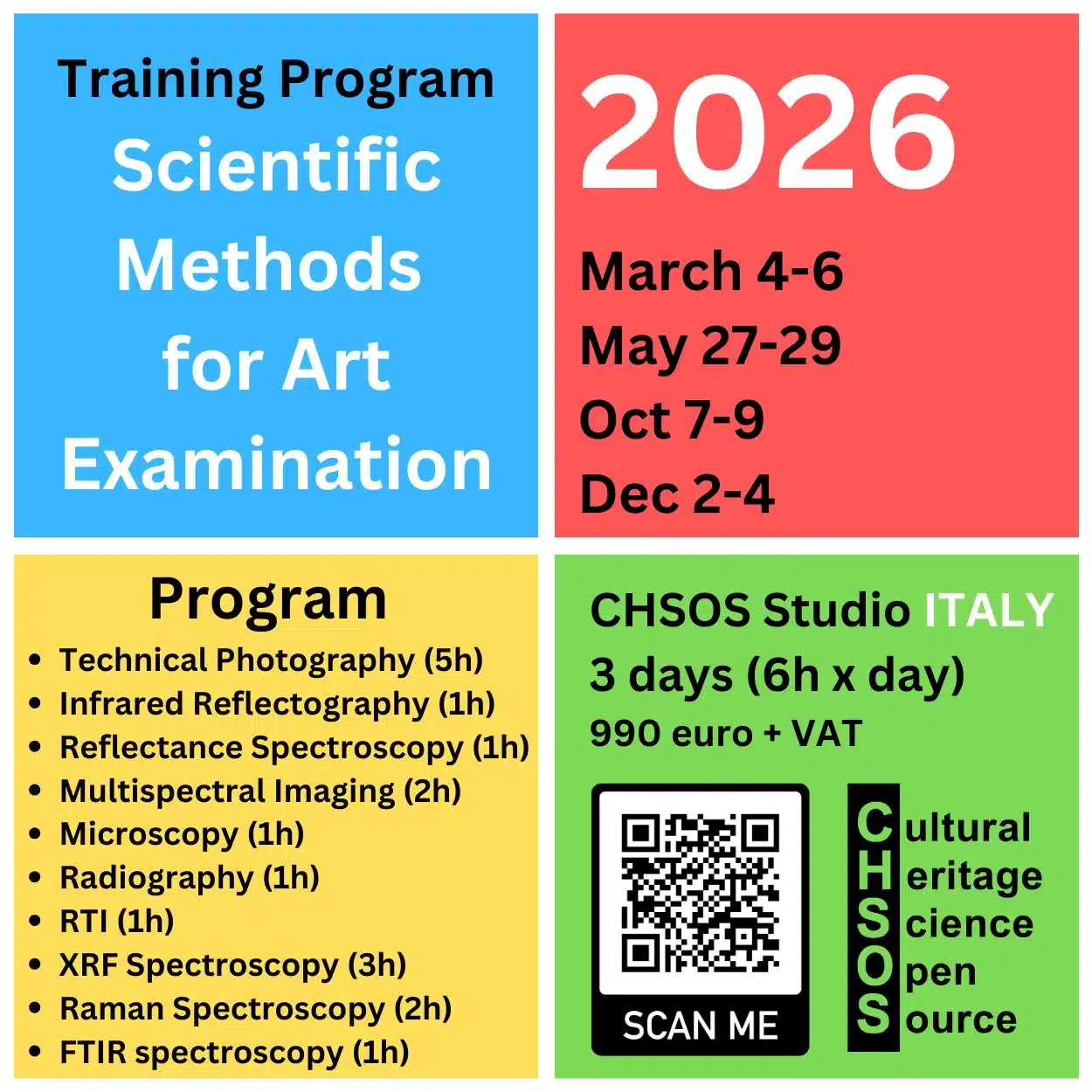
Training 2026

Scientific Art Examination – Resources:
Getty Conservation Institute (GCI) – USA
The British Museum – Scientific Research Department – UK
Scientific Research Department – The Metropolitan Museum of Art, New York, USA
C2RMF (Centre de Recherche et de Restauration des Musées de France) – France
Rijksmuseum – Science Department – Netherlands