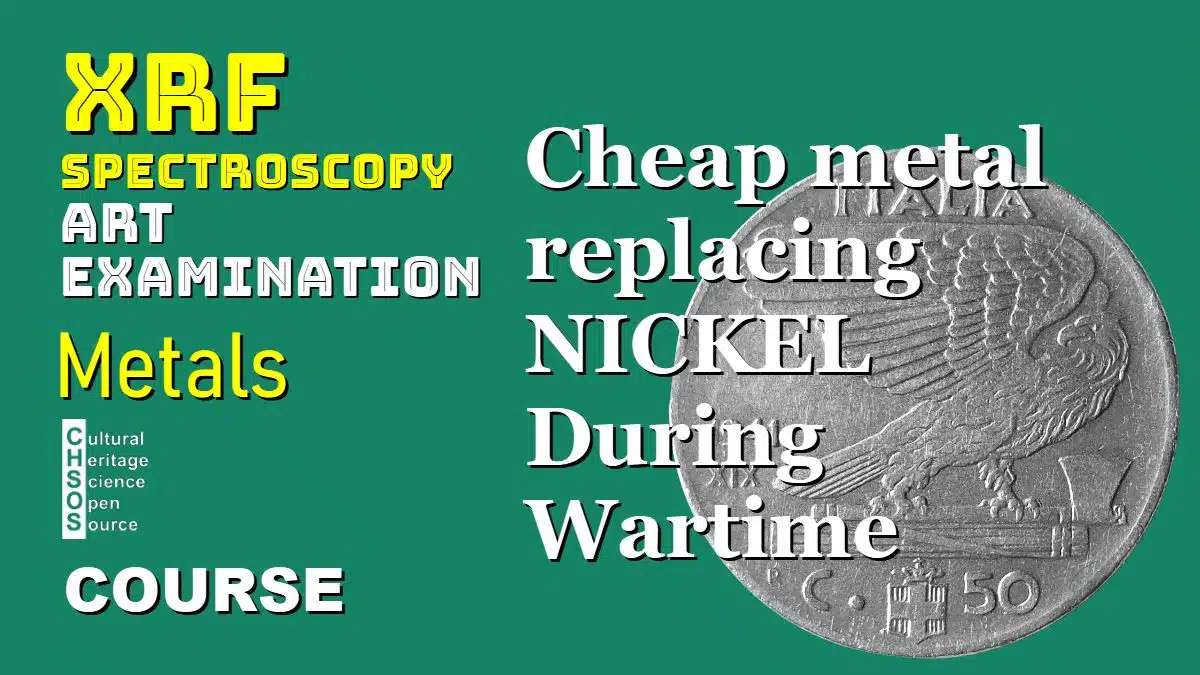
During wartime, strategic materials such as nickel and molybdenum were redirected to military needs, leading to changes in coinage alloys. This lesson focuses on the Italian 50 centesimi coins issued in 1939 and 1941, showing how their metallic composition shifted after Italy entered World War II in 1940.
Objectives
-
Understand how historical events influenced changes in coinage alloys.
-
Learn how simple tests, such as magnetism, can distinguish different alloys.
-
Interpret XRF spectra to identify the elemental composition of coins.
-
Recognize the replacement of nickel and molybdenum in coinage during wartime.
Materials
-
Two coins dated 1939 and 1941 (Italian 50 centesimi, “Eagle” type), composition ACMONITAL
-
Magnet
Lesson Plan
-
Present the historical background: Italy’s entry into WWII in 1940 and its impact on coinage.
-
Compare the two coins using a magnet to observe magnetic differences.
-
Analyze and discuss XRF spectra: the 1939 coin shows Fe, Cr, Ni, and traces of Mo; the 1941 coin shows only Fe and Cr.


To reinforce the concepts discussed here, we also provide a video lesson that visually walks through the key points of this topic. Watching the video alongside the text can help you better understand and apply these ideas in practice.


The course XRF Spectroscopy for Art Examination introduces conservators, art historians, and scientists with interest in Art to the principles and practical applications of X-ray fluorescence (XRF) spectroscopy in the examination of artworks. The course starts with basic principles of XRF and gradually explores its role in identifying materials and methods used in the creation and conservation of art.
Course Objectives
- Understand the fundamentals of XRF spectroscopy and how it applies to the analysis of art.
- Learn the key features and limitations of XRF for examining art and archaeology.
- Gain skills in interpreting XRF spectra to identify specific elements in paint layers, inks and metals.