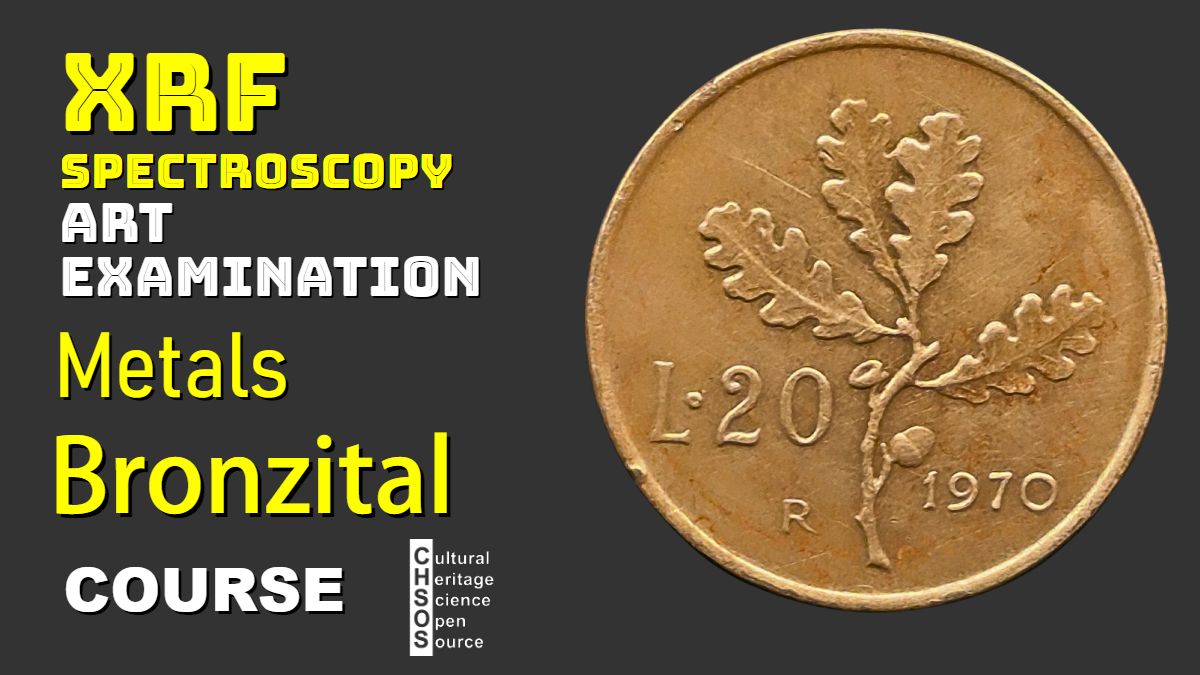
This lesson explores Bronzital, a copper-based alloy developed in Italy from 1926. It focuses on its composition, historical use in coinage, and its characterization with XRF spectroscopy. Students will analyze spectra from Bronzital coins to understand alloy identification and the challenges in detecting low-Z elements.
Objectives
-
Recognize its role in Italian coinage from 1926 onward.
-
Interpret XRF spectra of Bronzital coins.
-
Identify limitations of detecting aluminum with standard XRF setups.
Materials
-
Example Bronzital coins (e.g., 20 lire 1970, 200 lire 1978)
-
XRF instrument with adjustable filter setup
Lesson Plan
-
Introduce Bronzital: copper–aluminum alloy, with ~90% Cu, ~8% Al, ~2% Ni
-
Examine two coin examples: 20 lire (1970) and 200 lire (1978).
-
Present XRF spectra: copper peaks dominant, nickel visible, aluminum initially absent.
-
Explain why aluminum’s low atomic number requires a no-filter setup to reveal the 1.5 keV peak.


To reinforce the concepts discussed here, we also provide a video lesson that visually walks through the key points of this topic. Watching the video alongside the text can help you better understand and apply these ideas in practice.


The course XRF Spectroscopy for Art Examination introduces conservators, art historians, and scientists with interest in Art to the principles and practical applications of X-ray fluorescence (XRF) spectroscopy in the examination of artworks. The course starts with basic principles of XRF and gradually explores its role in identifying materials and methods used in the creation and conservation of art.
Course Objectives
- Understand the fundamentals of XRF spectroscopy and how it applies to the analysis of art.
- Learn the key features and limitations of XRF for examining art and archaeology.
- Gain skills in interpreting XRF spectra to identify specific elements in paint layers, inks and metals.