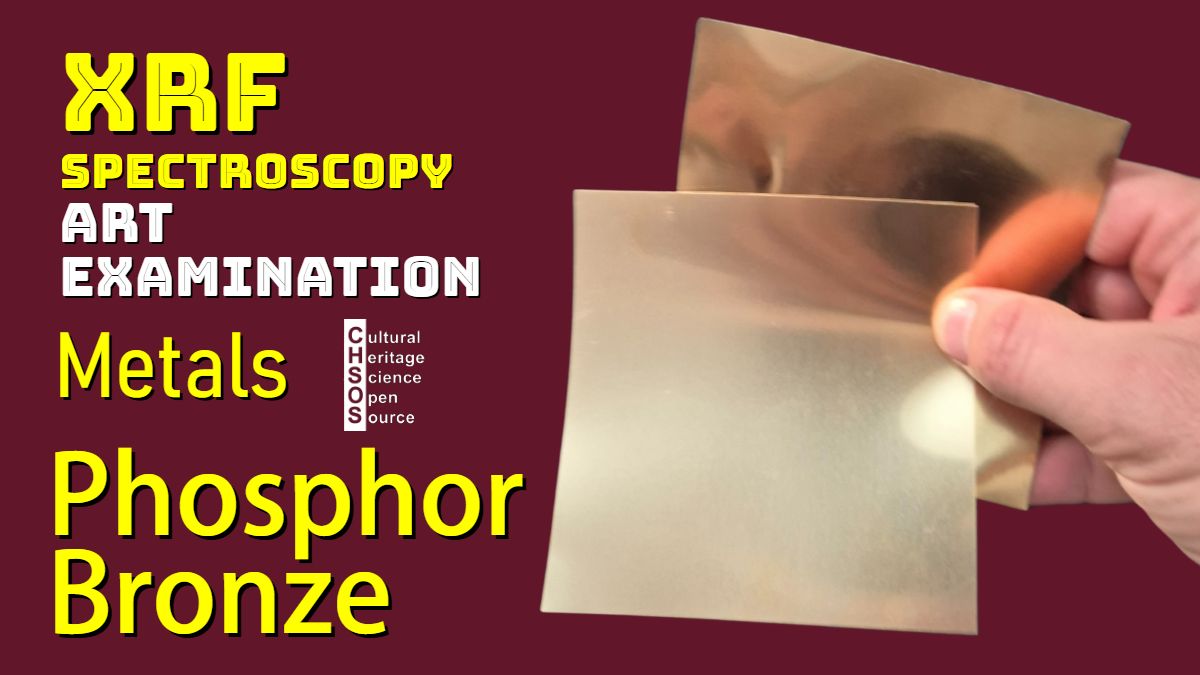
This lesson explores phosphor bronze, a modern variation of traditional bronze alloys. Building on previous discussions of copper and tin alloys, this session focuses on the role of phosphorus in enhancing material properties and the challenges it presents for elemental analysis using XRF spectroscopy.
Objectives
Identify the compositional differences between traditional, leaded, and phosphor bronzes.
Recognize the limitations of detecting low atomic number elements, such as phosphorus, in XRF analysis performed in air.
Compare XRF spectra of phosphor bronze with that of a standard bronze coin.
Materials
Phosphor bronze sample (e.g., guitar string or alloy specimen)
Bronze coin (e.g., 5 groszy, 1938)
Lesson Plan
Introduce the evolution from traditional to modern bronzes.
Discuss the composition and applications of phosphor bronze.
Perform XRF analysis of the phosphor bronze sample.
Compare results with the bronze coin spectrum.
Discuss the absence of detectable phosphorus and its analytical implications.
Video lesson


To reinforce the concepts discussed here, we also provide a video lesson that visually walks through the key points of this topic. Watching the video alongside the text can help you better understand and apply these ideas in practice.


The course XRF Spectroscopy for Art Examination introduces conservators, art historians, and scientists with interest in Art to the principles and practical applications of X-ray fluorescence (XRF) spectroscopy in the examination of artworks. The course starts with basic principles of XRF and gradually explores its role in identifying materials and methods used in the creation and conservation of art.
Course Objectives
- Understand the fundamentals of XRF spectroscopy and how it applies to the analysis of art.
- Learn the key features and limitations of XRF for examining art and archaeology.
- Gain skills in interpreting XRF spectra to identify specific elements in paint layers, inks and metals.