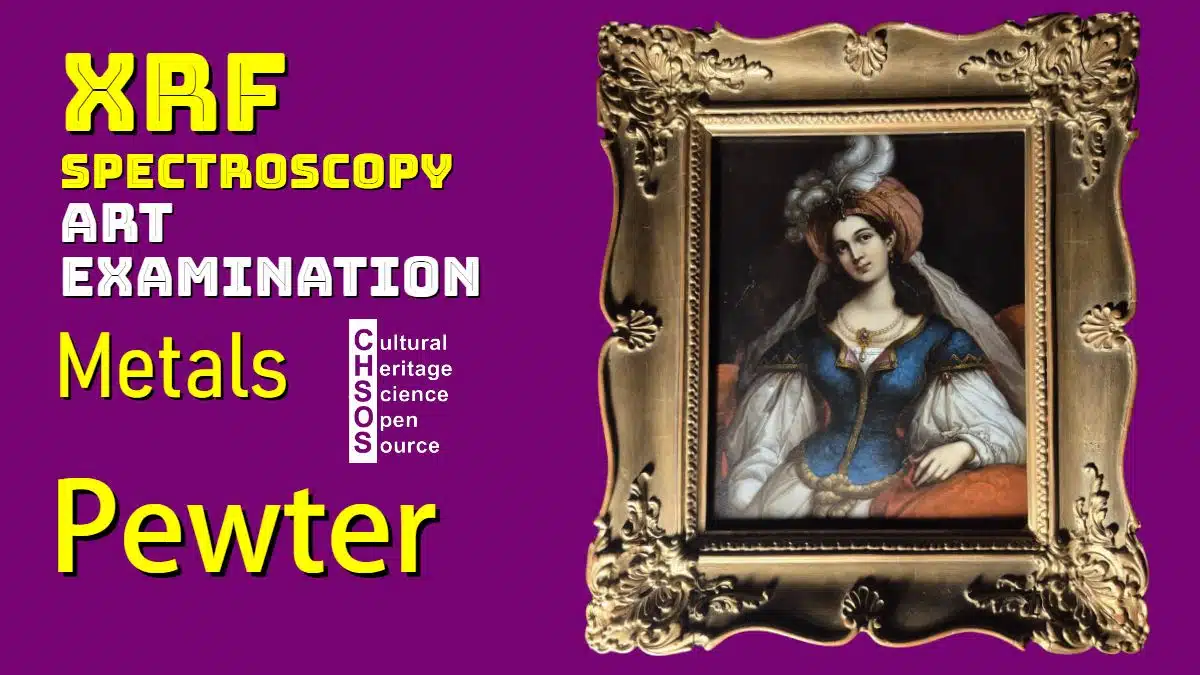
This lesson examines pewter, a tin-based alloy widely used from medieval times to the modern era. By comparing three objects—a 17th-century plate, a 19th-century painting support, and a 20th-century vase—students explore how pewter composition evolved as awareness of lead toxicity increased and new metals were introduced to improve performance and safety.
Objectives
-
Identify the main components of pewter and their historical variations.
-
Interpret XRF spectra to distinguish alloys containing lead, zinc, and antimony.
Materials
-
Pewter plate (17th century)
-
Pewter panel from a 19th-century painting
-
Pewter vase (early 20th century)
Lesson Plan
-
Introduce pewter as a tin-based alloy historically mixed with lead for hardness.
-
Analyze the 17th-century plate showing dominant tin and lead peaks in the XRF spectrum.
-
Examine the 19th-century painting support, noting the introduction of zinc and reduced lead content.
-
Study the 20th-century vase containing tin and antimony, with minimal lead.


To reinforce the concepts discussed here, we also provide a video lesson that visually walks through the key points of this topic. Watching the video alongside the text can help you better understand and apply these ideas in practice.


The course XRF Spectroscopy for Art Examination introduces conservators, art historians, and scientists with interest in Art to the principles and practical applications of X-ray fluorescence (XRF) spectroscopy in the examination of artworks. The course starts with basic principles of XRF and gradually explores its role in identifying materials and methods used in the creation and conservation of art.
Course Objectives
- Understand the fundamentals of XRF spectroscopy and how it applies to the analysis of art.
- Learn the key features and limitations of XRF for examining art and archaeology.
- Gain skills in interpreting XRF spectra to identify specific elements in paint layers, inks and metals.