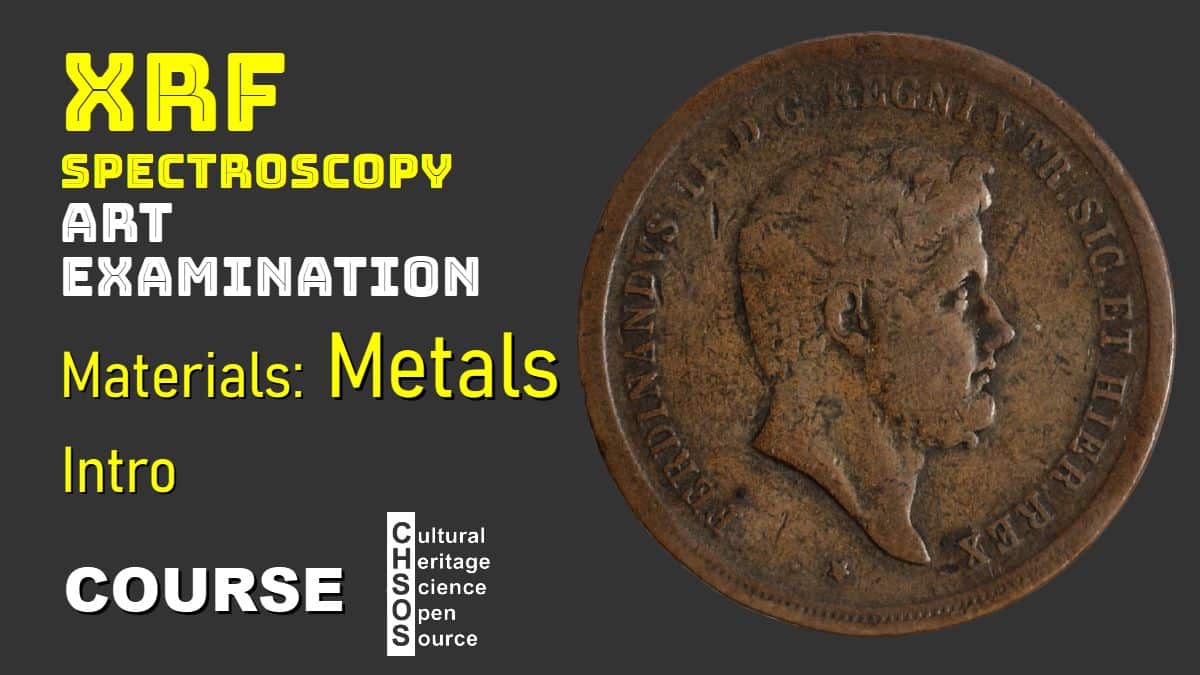
This lesson introduces a new series focused on metals and their alloys, particularly in the context of cultural heritage and archaeology. While a few metals are used in pure form, most are found in complex combinations known as alloys. Understanding these mixtures is essential for interpreting material composition through XRF analysis, especially when studying historical artifacts such as coins.
Objectives

- Identify key metals and alloys relevant to art examination and archaeology.
- Recognize the XRF lines of pure metals such as aluminum, chromium, iron, nickel, copper, zinc, silver, tin, gold, and lead.
- Understand how these elements combine to form common alloys.
- Learn how historical coins serve as practical case studies for alloy identification.


To reinforce the concepts discussed here, we also provide a video lesson that visually walks through the key points of this topic. Watching the video alongside the text can help you better understand and apply these ideas in practice.


The course XRF Spectroscopy for Art Examination introduces conservators, art historians, and scientists with interest in Art to the principles and practical applications of X-ray fluorescence (XRF) spectroscopy in the examination of artworks. The course starts with basic principles of XRF and gradually explores its role in identifying materials and methods used in the creation and conservation of art.
Course Objectives
- Understand the fundamentals of XRF spectroscopy and how it applies to the analysis of art.
- Learn the key features and limitations of XRF for examining art and archaeology.
- Gain skills in interpreting XRF spectra to identify specific elements in paint layers, inks and metals.