Home » Products » Ultraviolet Lamp » Fabrizio Versus the Fluorescent World » Chlorophyll UV Fluorescence
Fabrizio Versus the Fluorescent World: Chlorophyll
In this first experiment of Fabrizio Versus the Fluorescent World, we explore the fluorescence of chlorophyll, moving beyond materials typically studied in art examination. Instead of pigments, binders, or varnishes, we focus on a natural molecule fundamental to life on Earth: chlorophyll.
Chlorophyll is the molecule responsible for photosynthesis in plants. It absorbs light primarily in the blue–UV and red regions of the spectrum and uses this energy to drive the chemical reactions that produce sugars. While chlorophyll appears green in reflected light, its behavior under ultraviolet radiation reveals another important property: fluorescence. When excited by UV light, chlorophyll emits a deep red glow.
The experiment begins with fresh spinach leaves. When illuminated with a UV lamp in a dim environment, the leaves already show a faint red fluorescence. However, this effect is partially masked by the complex structure of the leaf and the presence of other compounds.
To better observe the phenomenon, chlorophyll is extracted from the leaves using ethanol. The spinach is crushed thoroughly to break open the plant cells and disrupt the chloroplasts—the microscopic organelles that contain chlorophyll. As ethanol is added and the mixture is ground, the green pigment dissolves into the solvent. After filtration, the resulting solution appears intensely green.
When the UV lamp is directed onto this chlorophyll solution in a darkened room, the transformation is striking. The liquid emits a vivid, strong red fluorescence. Without UV illumination, the solution simply appears green; under UV light, it glows bright red.
This simple extraction reveals how a common biological molecule can display powerful optical properties, making visible the hidden interaction between light and matter.
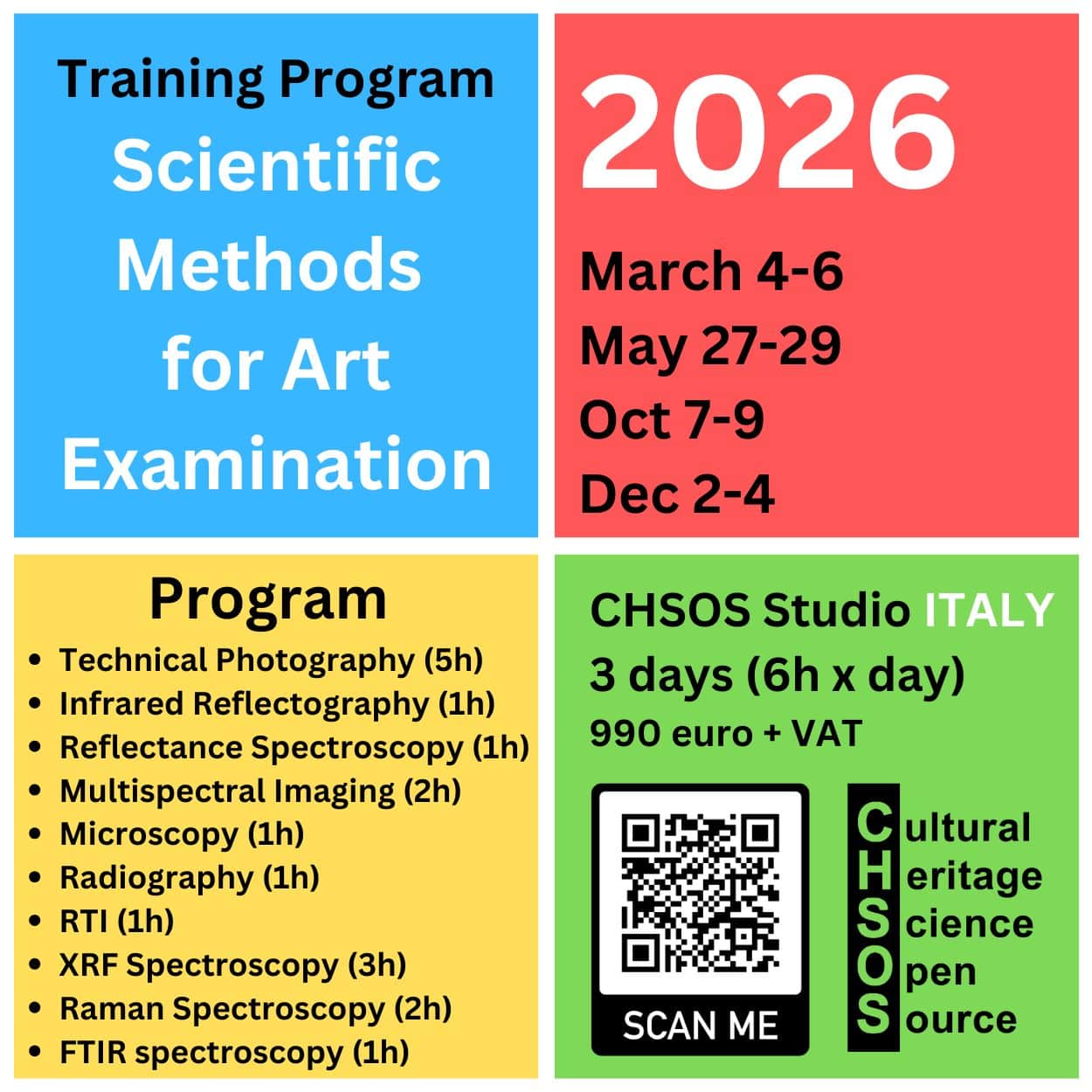
Learn Technical Photography for Art Examination
Technical Photography is one of the most powerful—and often overlooked—tools for the scientific examination of art and archaeology. If you are a conservator, scientist, or art collector and you are not yet familiar with this method, it is truly a missed opportunity. Using simple, affordable equipment and a clear methodology, Technical Photography allows you to reveal underdrawings, retouchings, material differences, and conservation issues in a completely non-invasive way. Far from being complex or inaccessible, it is an easy entry point into scientific analysis. In many cases, Technical Photography represents the first essential step toward a deeper understanding of artworks and archaeological objects.
Scientific Art Examination – Resources:
Getty Conservation Institute (GCI) – USA
The British Museum – Scientific Research Department – UK
Scientific Research Department – The Metropolitan Museum of Art, New York, USA
C2RMF (Centre de Recherche et de Restauration des Musées de France) – France
Rijksmuseum – Science Department – Netherlands