Fabrizio UV Lamp versus Drinks

drinks UV Fluorescence

Fabrizio Versus the Fluorescent World: Drinks

In this episode of the series “Fabrizio UV Lamp versus the Fluorescent World”, we explore a fascinating question: can ordinary drinks reveal hidden colors under ultraviolet light? The answer is yes. Many common beverages contain molecules that respond to ultraviolet radiation with striking Fluorescence. When illuminated with ultraviolet light, these molecules absorb invisible radiation and re-emit it as visible light, producing vivid glowing colors.

Using the Fabrizio UV Lamp, we examine three everyday liquids—tonic water, energy drinks, and olive oil—to reveal three different fluorescence colors. Each liquid contains a specific molecule responsible for the observed emission. Together they provide a simple but powerful demonstration of fluorescence in daily life.

Fabrizio UV Lamp versus Drinks

Table of Contents

Tonic Water and the Blue Fluorescence of Quinine

The first drink we test is Tonic water, a beverage well known for its characteristic bitter taste. By reading the ingredients label, we can identify the compound responsible for its fluorescence: Quinine.
Quinine is a natural alkaloid extracted from the bark of trees belonging to the genus Cinchona, which grow primarily in South America. Historically, quinine played a crucial role in medicine because it was widely used to treat and prevent malaria. Due to its strong bitterness, it was often dissolved in water to create tonic water.
A famous historical anecdote explains the origin of the gin and tonic cocktail. British soldiers stationed in tropical regions needed to consume quinine to protect themselves against malaria, but the drink was extremely bitter. To make it more palatable, they began mixing tonic water with gin. The result became one of the most iconic cocktails in the world.
When we illuminate tonic water with the Fabrizio UV Lamp, the liquid immediately emits a bright blue fluorescence. This occurs because quinine molecules absorb ultraviolet light and re-emit it in the blue region of the visible spectrum. The effect is so strong that tonic water is often used in classrooms and demonstrations to illustrate fluorescence.

Quinine emits a bright blue fluorescence when illuminated with the Fabrizio UV lamp

Energy Drinks and the Green-Yellow Glow of Vitamin B

Next we test a popular energy drink. By inspecting the ingredients, we can see that it contains several vitamins, including vitamin B6, vitamin B12, and especially Riboflavin, also known as vitamin B2.

Energy drinks often include B vitamins because they play an essential role in metabolism. These vitamins help the body convert food into energy for the cells, which is why they are commonly marketed in beverages intended to boost energy levels.

Riboflavin is particularly interesting for fluorescence experiments because the molecule itself is strongly fluorescent. When exposed to ultraviolet light from the Fabrizio UV Lamp, riboflavin emits a vivid green-yellow fluorescence. This glow is immediately visible and often much brighter than the fluorescence observed in many other everyday substances.

The intense emission arises from the structure of the riboflavin molecule, which contains an extended system of conjugated bonds capable of absorbing ultraviolet radiation and releasing part of that energy as visible light.

Riboflavin (vitamin B) emits a green-yellow fluorescence when illuminated with the Fabrizio UV lamp

Olive Oil and the Red Fluorescence of Chlorophyll

To complete our exploration of fluorescent beverages, we examine an unexpected candidate: olive oil. Unlike the previous drinks, olive oil does not contain quinine or riboflavin. Instead, its fluorescence originates from Chlorophyll.

Chlorophyll is the green pigment responsible for photosynthesis in plants. Although olive oil appears yellow-green under normal lighting conditions, chlorophyll exhibits a distinctive red fluorescence when illuminated with ultraviolet or blue light.

When we shine the Fabrizio UV Lamp onto the olive oil sample, the liquid emits a deep red glow. This fluorescence occurs because chlorophyll absorbs high-energy light and releases it at longer wavelengths in the red region of the spectrum.

Three Drinks, Three Fluorescent Colors

By comparing the three samples side by side, we obtain a simple but striking fluorescence demonstration:

  • Tonic water → blue fluorescence from quinine

  • Energy drink → green-yellow fluorescence from vitamin B

  • Olive oil → red fluorescence from chlorophyll

Together these liquids illustrate how different molecules emit different colors under ultraviolet light. This experiment highlights the beauty of fluorescence and shows how scientific phenomena can be observed using materials found in everyday life.

The Fabrizio UV Lamp makes these hidden optical properties visible, turning ordinary drinks into a colorful demonstration of chemistry and physics.

Tonic water (blue fluorescence from quinine), Energy drink (green-yellow fluorescence from riboflavin), Olive oil (red fluorescence from chlorophyll)


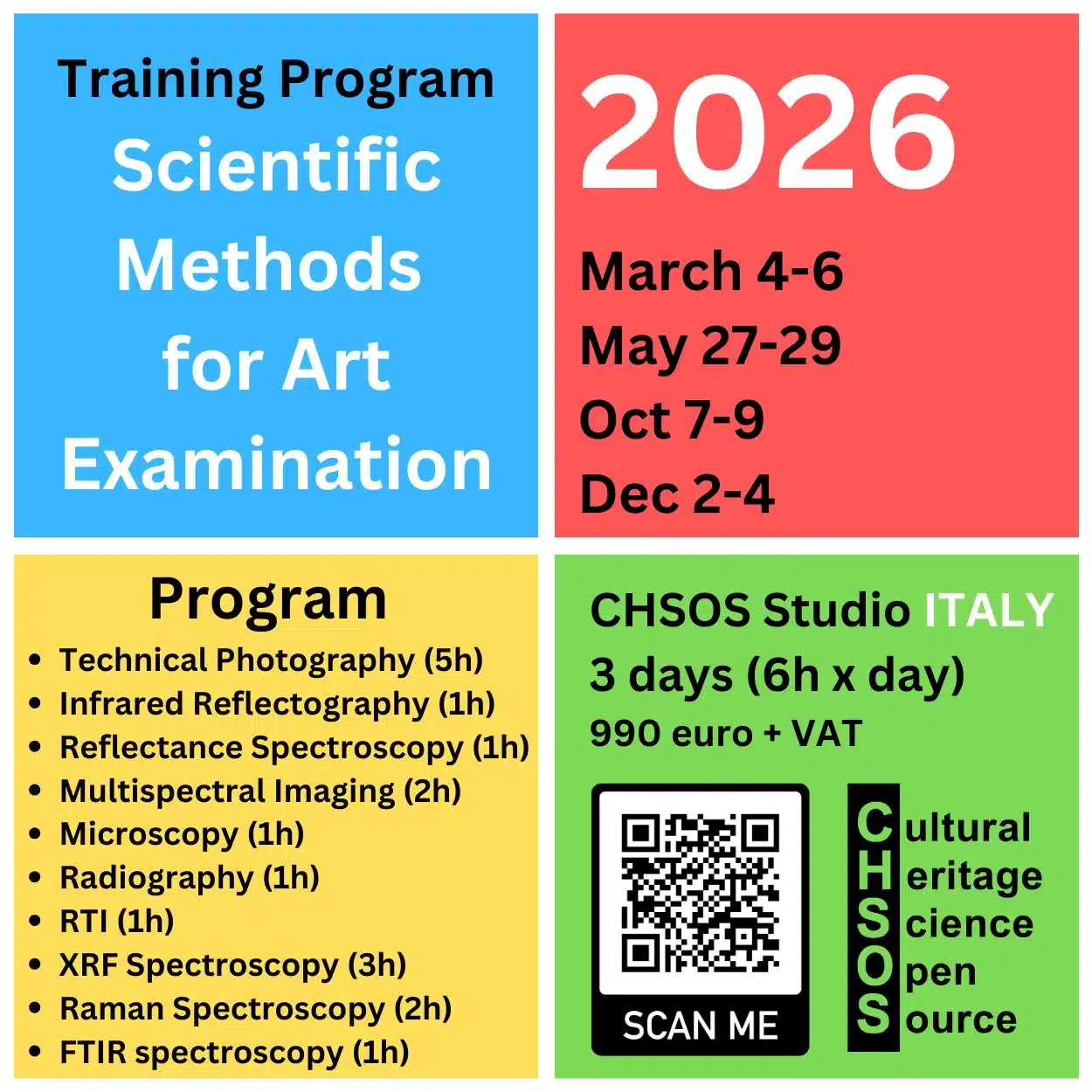
Learn Technical Photography for Art Examination

Technical Photography is one of the most powerful—and often overlooked—tools for the scientific examination of art and archaeology. If you are a conservator, scientist, or art collector and you are not yet familiar with this method, it is truly a missed opportunity. Using simple, affordable equipment and a clear methodology, Technical Photography allows you to reveal underdrawings, retouchings, material differences, and conservation issues in a completely non-invasive way. Far from being complex or inaccessible, it is an easy entry point into scientific analysis. In many cases, Technical Photography represents the first essential step toward a deeper understanding of artworks and archaeological objects.


Training 2026

Scientific Art Examination – Resources:
Getty Conservation Institute (GCI) – USA
The British Museum – Scientific Research Department – UK
Scientific Research Department – The Metropolitan Museum of Art, New York, USA
C2RMF (Centre de Recherche et de Restauration des Musées de France) – France
Rijksmuseum – Science Department – Netherlands