Home » Services » Technical Photography (TP) » Ultraviolet Fluorescence Photography (UVF)
Ultraviolet Fluorescence Photography (UVF)
What happens when artworks are illuminated with ultraviolet light?
Some materials absorb invisible UV radiation and re-emit it as visible light, producing the fascinating phenomenon known as Ultraviolet Fluorescence (UVF). The colors and intensity of this glow depend on the chemical composition and age of the materials.
In art examination, this simple but powerful technique can reveal varnishes, retouchings, restorations, and material differences that are completely invisible under normal lighting. Because it is non-invasive and relatively easy to perform, UV fluorescence photography has become one of the most useful tools in technical photography for the study and documentation of artworks.
In this page I introduce the basics of UV Fluorescence Photography (UVF) and how it can help conservators, scientists, and art professionals better understand the history and condition of artworks.
UVF is a phenomenon in which certain materials absorb invisible ultraviolet radiation and re-emit part of that energy as visible light. When illuminated with UV lamps, many natural and synthetic substances glow with characteristic colors—blues, greens, yellows, or reds—depending on their chemical composition. In artworks, this response can reveal information that is invisible under normal lighting.
In art examination, UV fluorescence is widely used as a fast, non-invasive diagnostic tool. Natural varnishes, resins, retouchings, adhesives, and some pigments fluoresce differently, allowing conservators and researchers to distinguish original materials from later additions. Areas of restoration often appear darker because modern retouching paints typically absorb UV radiation rather than fluoresce. Aged varnishes, on the other hand, commonly produce a greenish fluorescence that helps visualize their distribution and thickness.
Check out other applications of UV fluorescence beyond art examination in our series “Fabrizio vs the Fluorescent World.”
Table of Contents
Photographic setup
Applications in Art examination
References
| Publications on Ultraviolet Fluorescence photography (UVF) |
|---|
| A. Cosentino “Practical notes on ultraviolet technical photography for art examination” Conservar Património 21, 53-62, 2015. |
| A. Cosentino, M. Gil, M. Ribeiro, R. Di Mauro “Technical Photography for mural paintings: the newly discovered frescoes in Aci Sant’Antonio (Sicily, Italy)” Conservar Património 20, 23–33, 2014. |
| A. Cosentino “Identification of pigments by multispectral imaging a flowchart method” Heritage Science, 2:8, 2014. |
| A. Cosentino, S. Stout “Photoshop and Multispectral Imaging for Art Documentation” e-Preservation Science, 11, 91–98, 2014. |
| A. Cosentino “Effects of Different Binders on Technical Photography and Infrared Reflectography of 54 Historical Pigments” International Journal of Conservation Science, 6 (3), 287-298, 2015. |
Learn Technical Photography for Art Examination
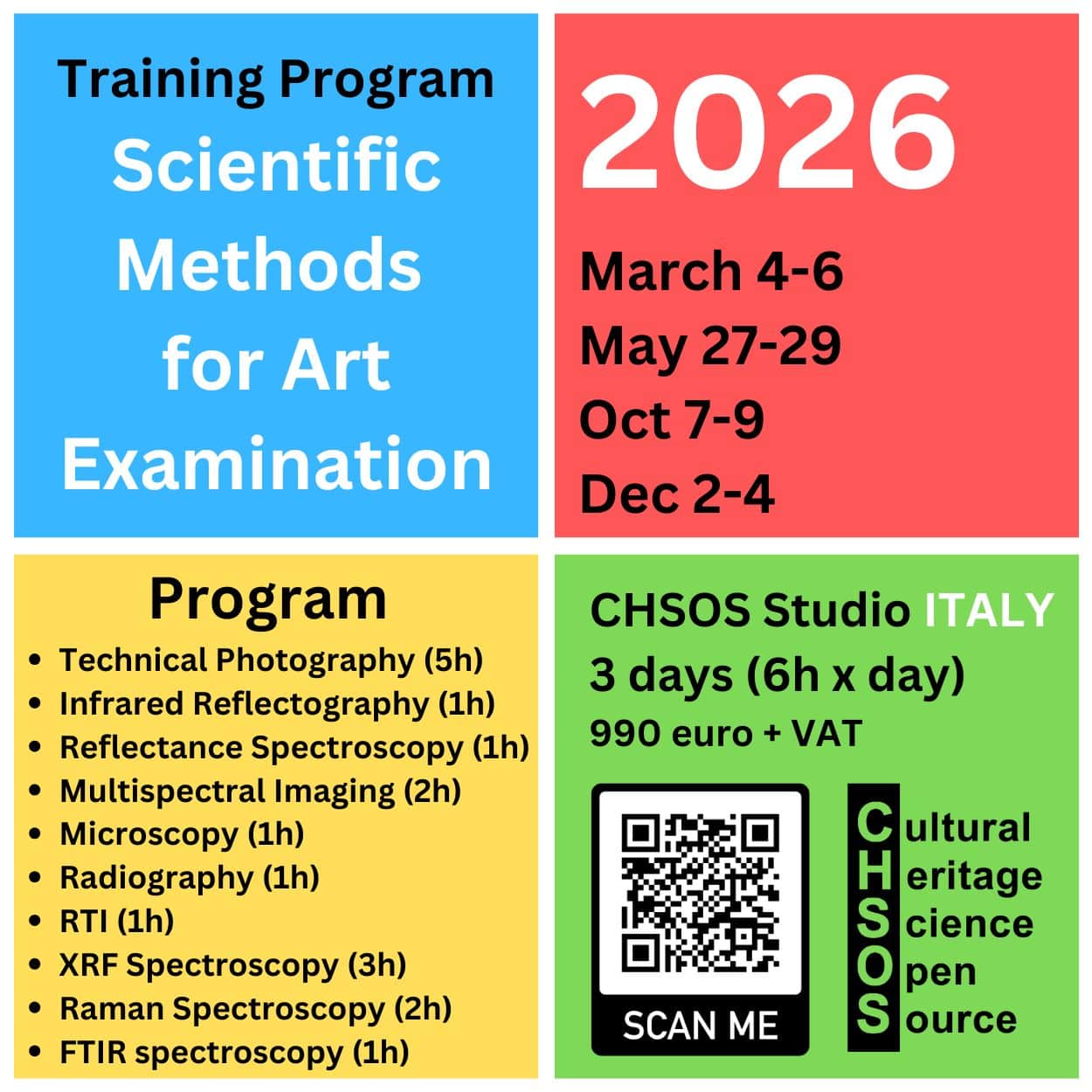
Technical Photography is one of the most powerful—and often overlooked—tools for the scientific examination of art and archaeology. If you are a conservator, scientist, or art collector and you are not yet familiar with this method, it is truly a missed opportunity. Using simple, affordable equipment and a clear methodology, Technical Photography allows you to reveal underdrawings, retouchings, material differences, and conservation issues in a completely non-invasive way. Far from being complex or inaccessible, it is an easy entry point into scientific analysis. In many cases, Technical Photography represents the first essential step toward a deeper understanding of artworks and archaeological objects.
Scientific Art Examination – Resources:
Getty Conservation Institute (GCI) – USA
The British Museum – Scientific Research Department – UK
Scientific Research Department – The Metropolitan Museum of Art, New York, USA
C2RMF (Centre de Recherche et de Restauration des Musées de France) – France
Rijksmuseum – Science Department – Netherlands
Case studies using UVF Photography
19th-century South-Asia Islamic manuscript
Early 20th-century Persian manuscript with a drawing attached over the text
20th-century serigraph print
17th-century print of the island of Seram in the Moluccas
17th century Umbrian School Madonna and Child
19th-century portrait in Orientalist style
19th-century Color Chart “Ratti Ernesto & C” – Turin -Italy
19th-century Sikh school miniature painting
19th-century icon “Feast of the Pokrov (Protection) of the Veil of the Mother of God”
19th-century icon Saint Nicholas
15th-Century Icon – Modern Study Replica
16th-century woodcut leaf from the Romische Historie