Home » Case Studies » 19th-century icon Saint Nicholas
19th-century icon Saint Nicholas
This Orthodox icon depicts Saint Nicholas the Wonderworker, shown half-length, blessing with his right hand and holding the Gospel in his left. He wears bishop’s vestments richly decorated with crosses and gold motifs, emphasizing his ecclesiastical authority. The gilded background symbolizes the divine realm. In the upper corners, Christ presents the Gospel and the Virgin presents the omophorion, recalling the vision affirming Nicholas’s role as bishop. The Cyrillic inscription identifies him, and the open Gospel bears a Church Slavonic text. Painted in the Russian tradition, likely 18th–19th century, the icon highlights Nicholas as bishop, teacher, and miracle-worker.
CHSOS Collection – item #32
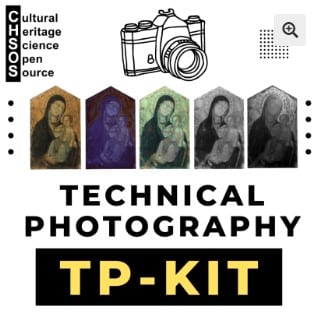
Technical Photography
Ultraviolet Fluorescence (UVF) – The retouched areas appear darker and are immediately mapped.
Infrared Photo (IR) – The IR image penetrates the paint layers, revealing underdrawing and compositional details not visible in normal light. The saint’s facial features and outlines of the garments are more schematically traced. The book text remains partially legible, but some figures and decorative details fade or change in appearance, indicating pigment differences due to the retouches.
Reflected Ultraviolet (UVR) – The UVR image highlights areas of retouching and later interventions. The surface abrasions are accentuated, making alterations more obvious than in visible light.
Infrared False Color (IRFC) – The IRFC image highlights areas of retouching, where pigments different from the originals have been used.


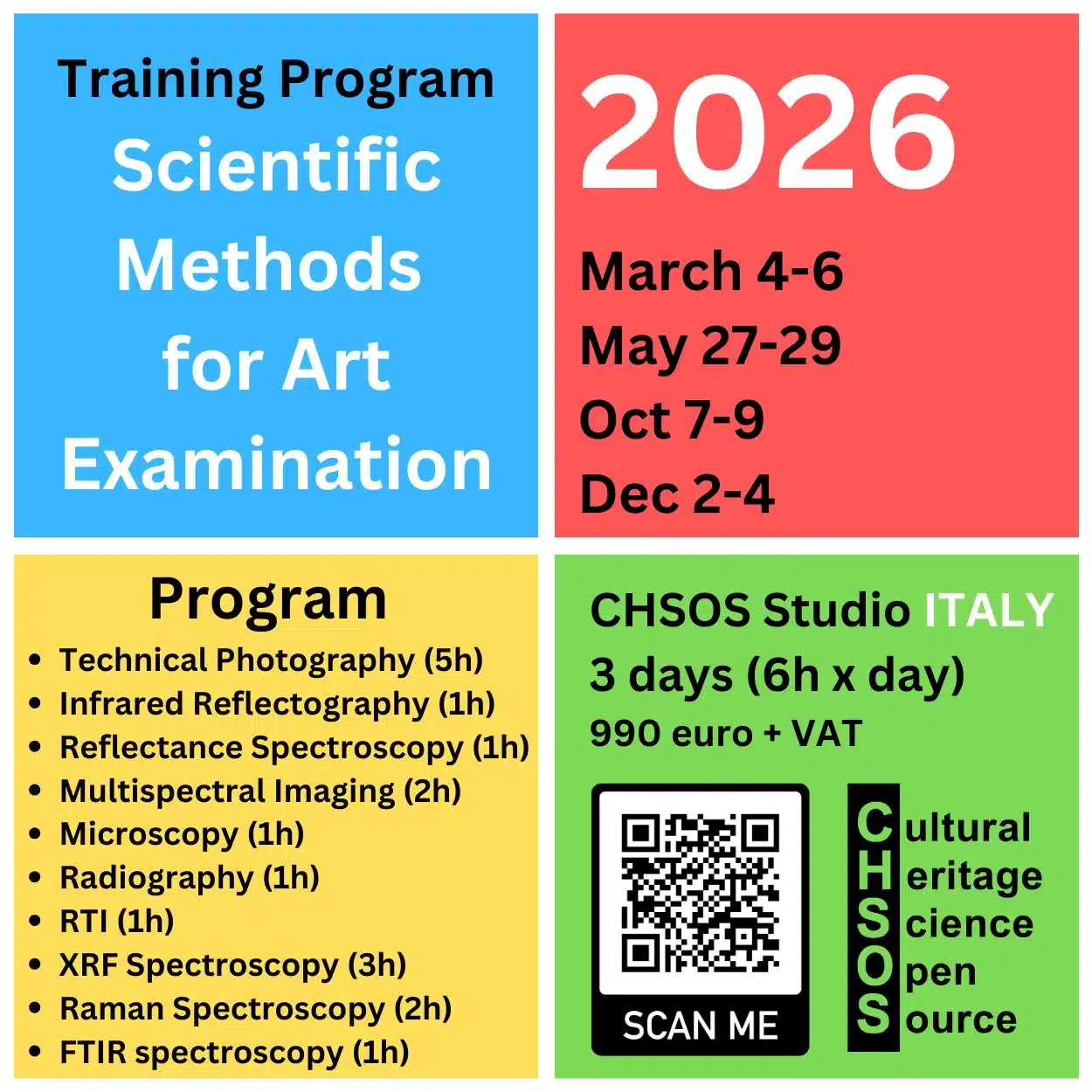
Learn Technical Photography for Art Examination
Technical Photography is one of the most powerful—and often overlooked—tools for the scientific examination of art and archaeology. If you are a conservator, scientist, or art collector and you are not yet familiar with this method, it is truly a missed opportunity. Using simple, affordable equipment and a clear methodology, Technical Photography allows you to reveal underdrawings, retouchings, material differences, and conservation issues in a completely non-invasive way. Far from being complex or inaccessible, it is an easy entry point into scientific analysis. In many cases, Technical Photography represents the first essential step toward a deeper understanding of artworks and archaeological objects.
Scientific Art Examination – Resources:
Getty Conservation Institute (GCI) – USA
The British Museum – Scientific Research Department – UK
Scientific Research Department – The Metropolitan Museum of Art, New York, USA
C2RMF (Centre de Recherche et de Restauration des Musées de France) – France
Rijksmuseum – Science Department – Netherlands