Art Conservation Science Techniques and Innovations - Page 52 of 56 - Cultural Heritage Science Open Source

microscope

A budget microscope for art examination

I have often been asked what kind of microscope is good for art examination. Briefly, you need a trinocular polarizing microscope with epillumination (from the top) and transmitted illumination (light from the bottom). I used to work in Brooklyn with the glorious  polarizing microscope Nikon OPTIPHOT 66. Moving back home in Italy I needed to buy

Read More »
IRF

Infrared Fluorescence Photography: visible-only lamp

Visible LED lamps have an infrared component other than visible light. This infrared light gives a noise in the infrared fluorescence photography.  White LED lamp emits Infrared roughly between 700 and 800. See Wikipedia; white LEDs are Phosphor-based LEDs and have an emission curve with a tail in the very close IR, see here. So, for a perfect IR

Read More »
gouche

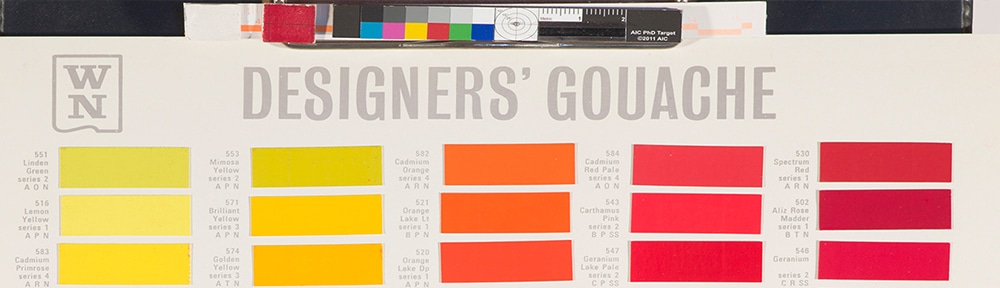
Winsor & Newton Gouache: Multispectral Imaging

Gouache, from the Italian guazzo, is a method of painting with opaque colors ground in water and thickened with gum and honey. The Head of Conservation at The Bergen Museum of Art, MSc. Yngve Magnusson, was so kind to send me over a Winsor and Newton Color Chart of Designer’s Gouache to  be tested by Technical

Read More »
Scientific Technical Photography

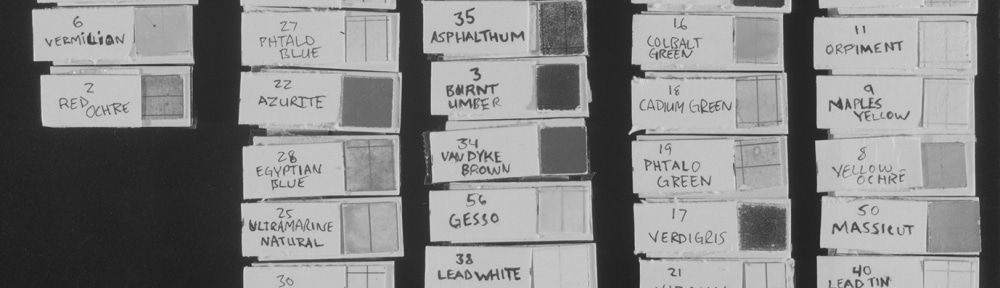
Technical Photography of Historical Pigments

I’m sharing in this post the Technical Photography images of my Historical Pigments swatches collection painted with gum arabic. I used a Nikon D800 36 MP modified for UV-VIS-IR and the set of filters for multispectral imaging described here. All the images are shot RAW and then edited in Camera RAW. VIS (Visible). Be sure

Read More »
microscopy-textile

Microscopy for Art Examination: Identifying textiles

A polarizing microscope is a quick method to identify textiles such as  painting canvases. To identify common historical textile such as cotton, hemp, wool, silk and flax you have to look at certain features. For example, cotton is easily recognized because its fibers show a characteristic twisted shape while hemp, jute and flax are pretty

Read More »