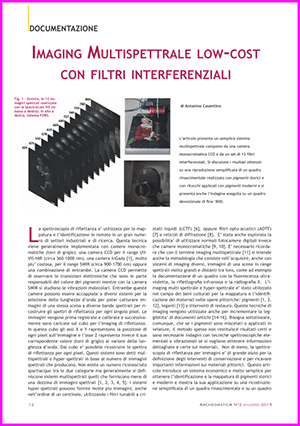
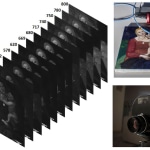
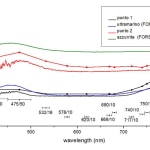
Multispectral imaging systems are used in art examination in order to map and identify pigments and binders as well as retouches. A monochromatic camera (CCD or InGaAs) is combined with an appropriate wavelength selection system, simple as a set of interferential filters or powerful but expensive as liquid-crystal tunable filters. A variable number of spectral images of a scene are then acquired and stacked into a reflectance imaging cube to be used to reconstruct reflectance spectra from each of their pixel.
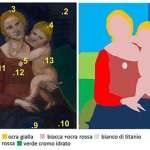
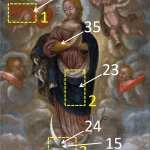
This work presents an affordable and simple multispectral imaging system composed of a monochromatic CCD camera and a set of only 12 interferential filters. The system was tested on a mock-up painting realized with traditional and modern pigments and also on a late 1800 authentic oil painting. This system is of particular interest for the cultural heritage sector because of its hardware simplicity, the acquisition speed as well as its lightweight and small dimensions. It must be pointed out that since its small number of filters, this system has limited analytical capacity and it must be used only for the preliminary mapping and identification of the pigments.
Our crowdfunding project keeps to grow! Collected 136% funding in 1 month! 38 people have contributed! “Multispectral Imaging for Art and Archaeology” is the first crowd funding project related to Art Conservation Science. For the first time, research funding is coming directly from the final users of this new tool for scientific examination of works of…
New York Conservation Foundation (NYCF) invited CHSOS in New York and NJ for three eye-opening and empowering presentations on our systems to do Technical Photography and Multispectral Imaging for Art and Archaeology. The Eastern Analytical Symposium, the New York Microscopical Society, and NYCF provided the lecture and workshop venues. November 17 in Somerset, NJ, we delivered a 25 minute…
This new paper is a valid example of the application of non‐invasive imaging methods (technical photography and multispectral imaging) before and after the conservation treatment of a work of art.
Our crowdfunding campaign is done! We just got over funded and we collected 203% of the goal funding in 2 months! We got 43 contributions from 16 Countries. “Multispectral Imaging for Art and Archaeology” is the first crowd funding project related to Art Conservation Science. For the first time, research funding is coming directly from the final…
Just published “Multispectral Imaging and the Art Expert” Spectroscopy Europe, 27, 2, 2015. Free Download: our latest paper on multispectral imaging for art and archaeology. This work has been possible thanks to PixelTeq which kindly provided the SpectroCam VIS and the filters set. CHSOS is researching into multispectral imaging and has launched the first…
Our crowdfunding project just got over funded! We collected 114% funding in 3 weeks! “Multispectral Imaging for Art and Archaeology” is the first crowd funding project related to Art Conservation Science. For the first time, research funding is coming directly from the final users of this new tool for scientific examination of works of art. Multispectral…