Gorgias-Titanium-white-anatase-rutile reflectance spectroscopy

Gorgias for dating Indian Mughal manuscripts
Gorgias for dating Indian Mughal manuscripts

Dating Indian Mughal manuscripts requires reliable, non-invasive methods capable of revealing both the materials and techniques used by artists. Reflectance spectroscopy offers a rapid approach to identify pigments and detect anachronistic materials that may indicate later interventions or modern forgeries.
The CHSOS Gorgias Reflectance Spectroscopy System captures high-quality spectral data directly from manuscript surfaces without sampling, providing valuable information for conservators, researchers, and collectors.
Combined with complementary analytical techniques, Gorgias helps establish a more accurate chronological framework by distinguishing historical pigments from modern ones, supporting authentication studies while preserving the integrity of these precious and irreplaceable cultural heritage objects.

Table of Contents

Titanum white, rutile or anatase?

Titanium white is a general name to indicate a white pigment that is made of one (or a mixture) of the two forms of titanium oxide: anatase and rutile. These crystals have the same chemical formula, TiO2, but different relative positioning of the 3 atoms (they are 2 polymorphs of titanium oxide).
The standard Pigments Checker v.5 has the rutile titanium white. Nowadays titanium white is all made from rutile. But this was not always the case. From about 1920 titanium white was made mostly of anatase because it was easier to produce. From about 1940 a cheap production method for rutile was established and it replaced anatase since it was more lightfast and had a stronger hiding power.
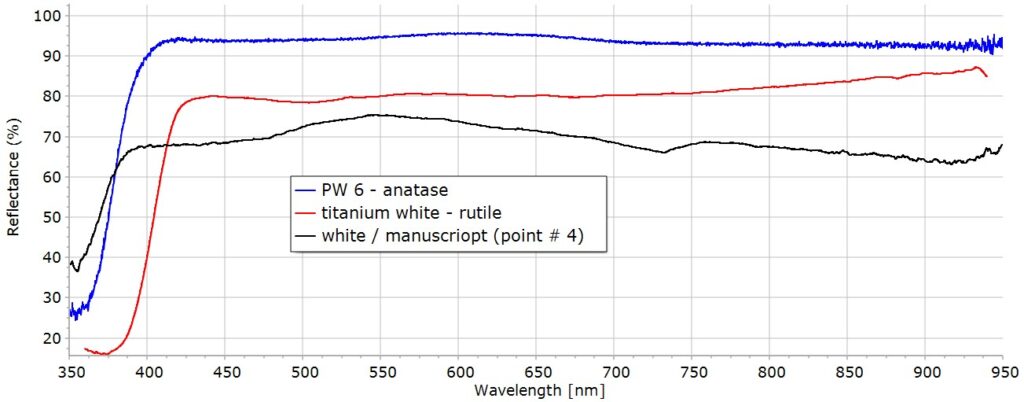
The new “modern and contemporary art” pigments checker has the “anatase” titanium white. Figure [1] shows the reflectance spectra of the two types of titanium white, anatase, and rutile acquired on the two pigments checkers, “standard” and “modern & contemporary art”.

Gorgias reflectance spectroscopy spectra database
Figure [1]. Reflectance spectra of the two types of titanium white, anatase and rutile, and of the white paint on an Indian Mughal manuscript.

The two types of titanium white can be distinguished by their reflectance spectra since the absorption band in the UV has the inflection point at 405 nm for rutile and 380 nm for anatase.
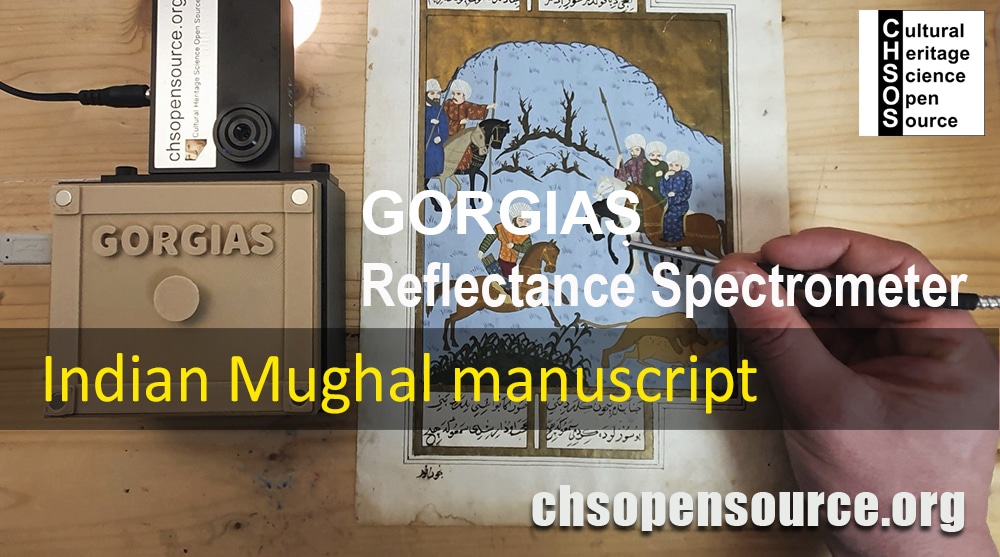
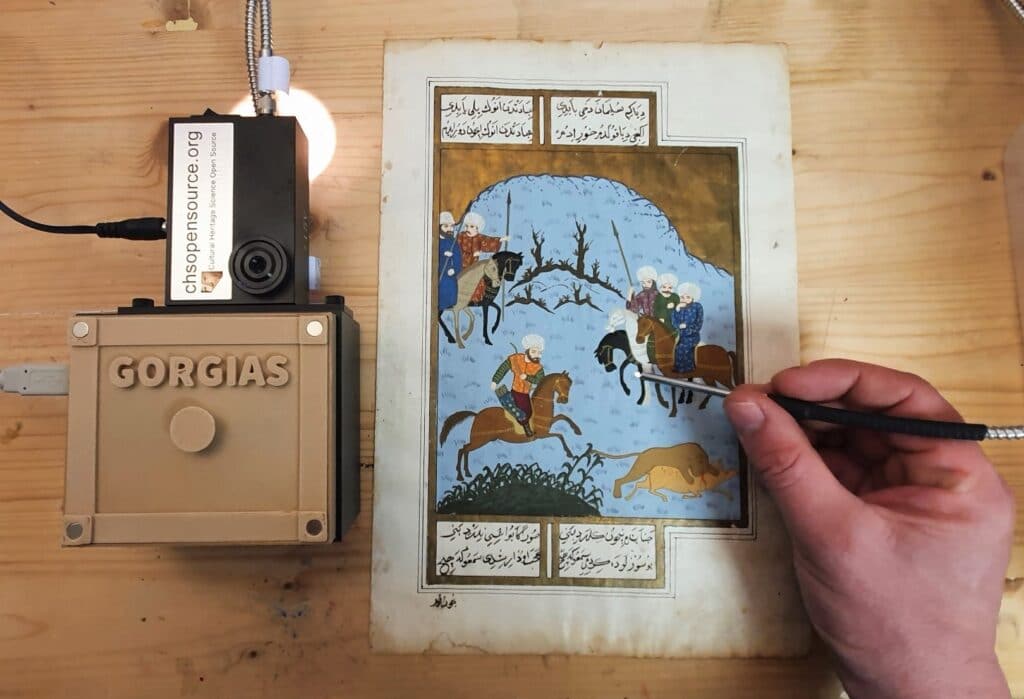
We did test the Gorgias spectrometer on an Indian Mughal manuscript that was supposed to be from the 18th century, likely 1790, figure [2].

Gorgias spectrometer on a Indian Mughal manuscript


We were interested in evaluating the authenticity of the item and, in particular, its dating. As shown in figure [1] the spectrum of the white paint (point 4) is comparable to the spectrum of anatase. This type of titanium white was also confirmed with the Raman Spectroscopy system ElviRA.

We know that anatase was in use from roughly 1920’-1940’. For a manuscript supposedly made in the 18th century, we were expecting lead white pigment, definitely not anatase. Furthermore, the identification of anatase indicates that the object was created not much later than the 1940’, otherwise, we should have found more of the rutile titanium white.


A. Cosentino “Application note 4: Gorgias Reflectance Spectra Database for Pigments Checker Modern & Contemporary Art” 2022.
Case Studies using Reflectance Spectroscopy

17th century Umbrian School Madonna and Child