reflectance spectroscopy for art chsos

Reflectance Spectroscopy (RS)

Reflectance Spectroscopy (RS)

Reflectance Spectroscopy (RS) has become a powerful portable technique for the analysis of polychrome artworks, particularly for pigment identification. Compared to other commonly used spectroscopic methods such as XRF and Raman, a key advantage of RS is that its instrumentation can be assembled using relatively low-cost components.

RS measures, at each wavelength, the ratio between the intensity of reflected light and incident light relative to a standard white reference (reflectance). The resulting reflectance spectra provide characteristic information that can be used to identify pigments.

As a non-invasive analytical method, reflectance spectroscopy is especially suited to the examination of artworks. It is based on the principle that materials interact with light in different ways: specific wavelengths are absorbed while others are reflected. By analyzing these spectral responses, it is possible to obtain a diagnostic “fingerprint” of the materials present and thereby determine their composition.

Table of Contents

Equipment

Spectrometer: The primary instrument used to measure the intensity of reflected light as a function of wavelength.

Light source: Provides a broad spectral output, typically covering the visible, ultraviolet (UV), and near-infrared (NIR) regions.

Fiber optics: Used to deliver light to the artwork surface and to collect the reflected radiation for subsequent analysis.

Benefits

Non-invasive and non-destructive: Reflectance spectroscopy does not require physical sampling, making it safe for valuable and delicate artworks.

Rapid and in situ analysis: Measurements can be acquired quickly and directly on the artwork, often without the need for relocation.

Applications in Art Examination

Pigment identification: Reflectance spectroscopy enables the identification of pigments in a painting by comparing measured spectra with reference spectra of known materials. This allows the reconstruction of the artist’s palette and provides insights into the techniques employed.

Gorgias

Gorgias, our reflectance spectroscopy system, is specifically designed for applications in art and archaeology. The spectrometer operates over a spectral range of 350–1000 nm.

Gorgias-woodcut-prints reflectance spectroscopy
Gorgias is a reflectance spectroscopy system for art and archaeology, covering 350–1000 nm.

GorgiasUV

GorgiasUV is based on Gorgias and extends the spectral range into the UV down to 200 nm.

GorgiasUV Reflectance Spectroscopy system

FREE Spectra Databases

We provide free spectral databases acquired with our reflectance spectrometers, Gorgias and GorgiasUV. Visit the Pigments Checker webpage to download them. These databases enable immediate comparison of your measurements with certified historical and modern pigment references.

FREE Reflectance Spectra Databases
Free Spectra Databases from Gorgias and GorgiasUV—download via Pigments Checker and instantly compare your measurements with certified historical and modern pigment references.

FREE Online Course

FREE Reflectance Spectroscopy (RS) Online Course: learn how to identify pigments using spectral databases and our spectrometers.

Reflectance Spectroscopy FREE course
Join our FREE Reflectance Spectroscopy (RS) online course and learn how to identify pigments using spectral databases and our spectrometers.

Resources

Case Studies using Reflectance Spectroscopy

17th century Umbrian School Madonna and Child


Learn Technical Photography for Art Examination

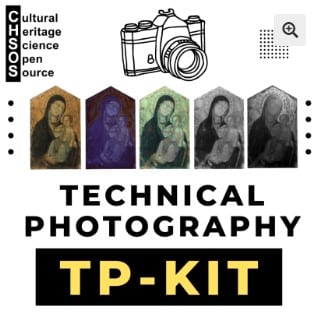
Technical Photography is one of the most powerful—and often overlooked—tools for the scientific examination of art and archaeology. If you are a conservator, scientist, or art collector and you are not yet familiar with this method, it is truly a missed opportunity. Using simple, affordable equipment and a clear methodology, Technical Photography allows you to reveal underdrawings, retouchings, material differences, and conservation issues in a completely non-invasive way. Far from being complex or inaccessible, it is an easy entry point into scientific analysis. In many cases, Technical Photography represents the first essential step toward a deeper understanding of artworks and archaeological objects.


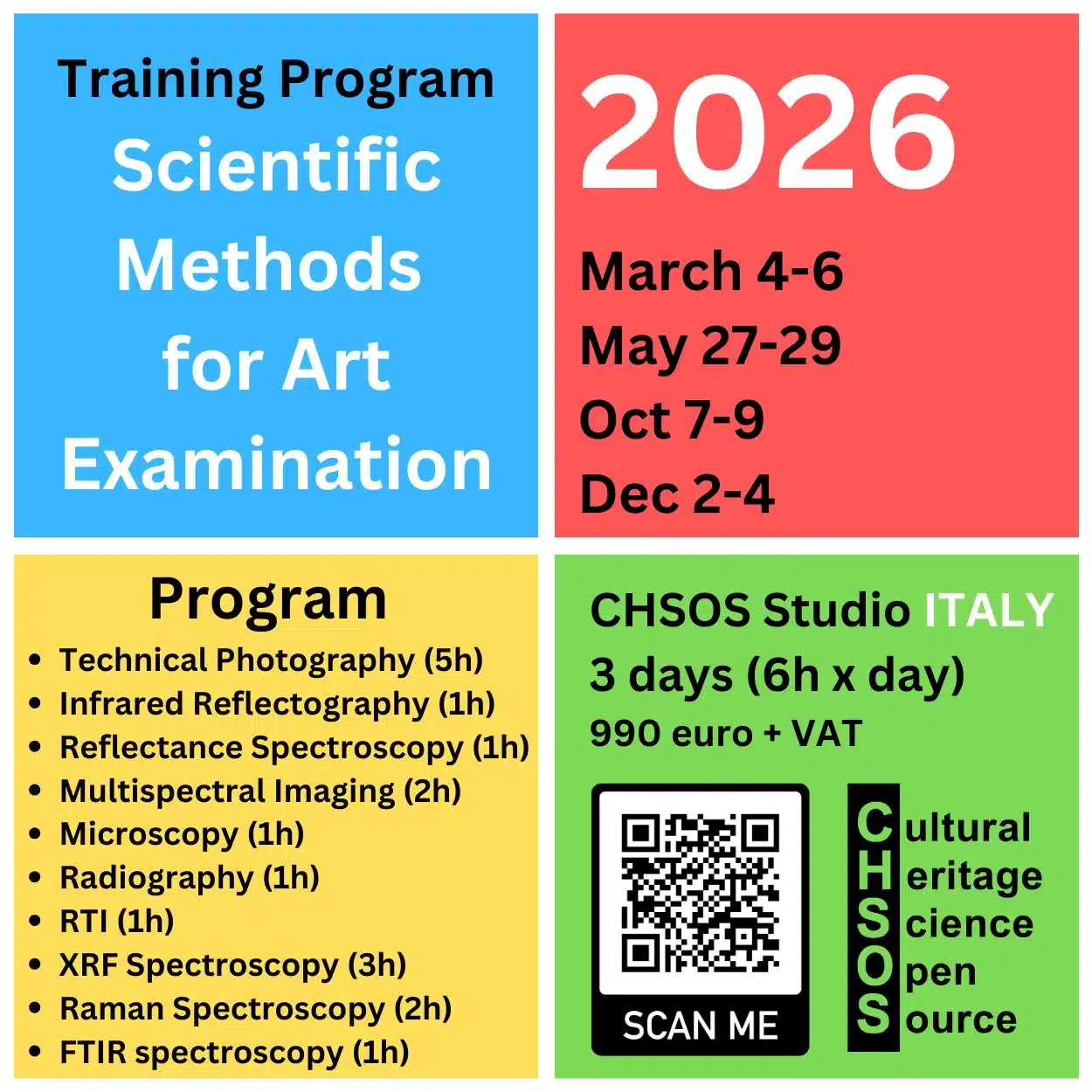
Training 2026

Scientific Art Examination – Resources:
Getty Conservation Institute (GCI) – USA
The British Museum – Scientific Research Department – UK
Scientific Research Department – The Metropolitan Museum of Art, New York, USA
C2RMF (Centre de Recherche et de Restauration des Musées de France) – France
Rijksmuseum – Science Department – Netherlands