Case Studies
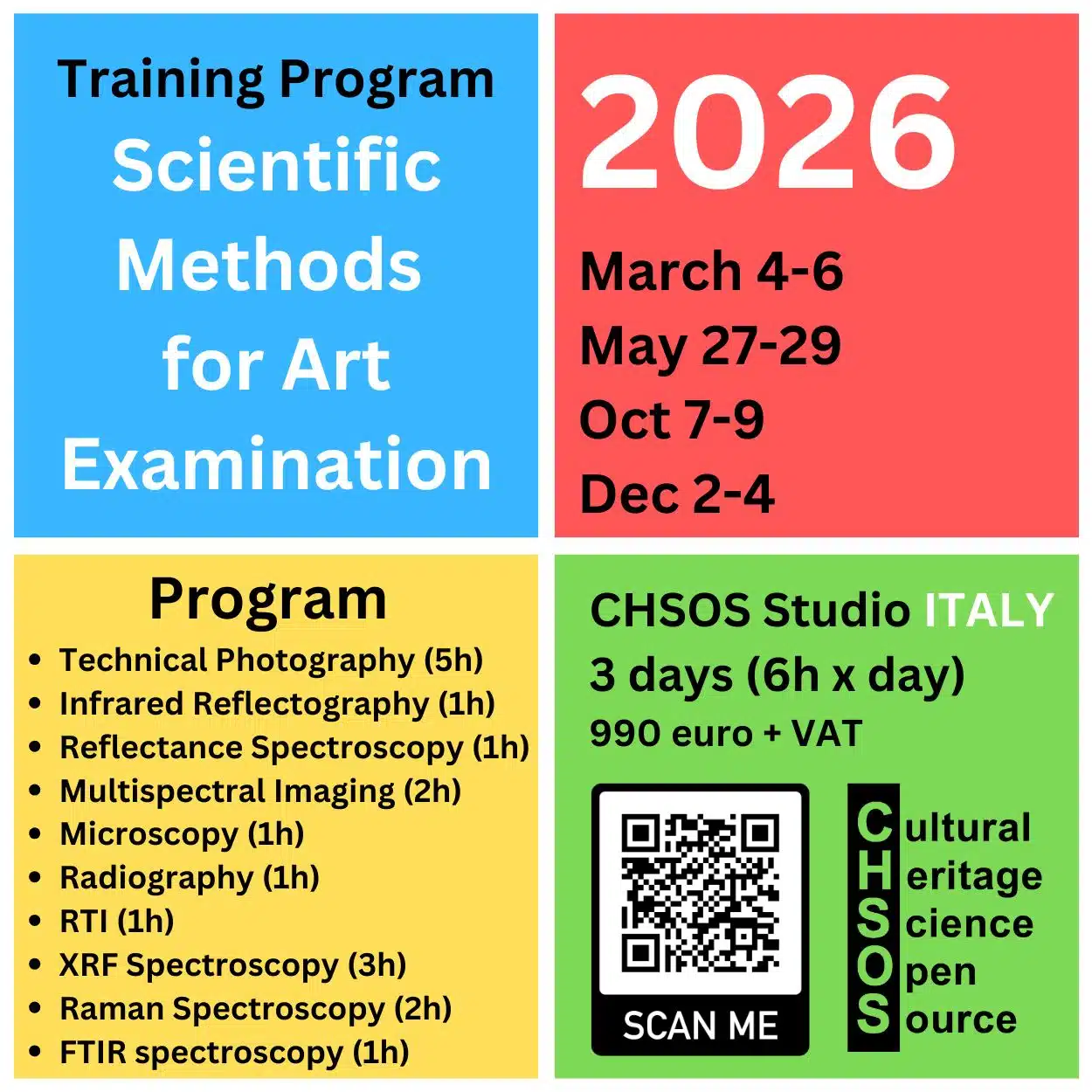
Our lab features an educational collection of artworks and materials used as case studies to demonstrate the practical application of our instruments and methods for art examination — from imaging to spectroscopy, including Technical Photography, Raman spectroscopy, XRF spectroscopy, and more. These case studies are an essential part of our teaching and research activity, allowing us to connect theory with hands-on practice.
Working with real objects provides a deeper understanding of the techniques, their potential, and their limitations. Through direct examples, we can show how different analytical tools complement one another and how the results contribute to the study, documentation, and conservation of works of art. The educational collection includes a wide range of materials and conditions, offering situations similar to those encountered in professional conservation studios, museums, and archaeological research.
We believe that case studies are among the most effective ways to learn. Seeing how imaging and spectroscopy are applied in concrete situations helps develop both technical competence and critical thinking — the ability to interpret data in context, evaluate results, and make informed decisions.
We also hope that the examples presented here will inspire you to explore your own collection — whether it belongs to a private owner, a museum, or an institutional archive. Each artwork has its own story to tell, and scientific examination offers powerful tools to uncover and understand it.
We periodically add new case studies to this educational collection, reflecting ongoing research and new applications of our methods. Keep an eye on this page for updates and discoveries from our lab.


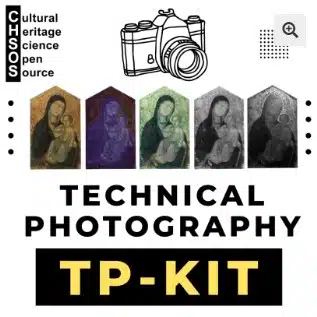
Learn Technical Photography for Art Examination
Technical Photography is one of the most powerful—and often overlooked—tools for the scientific examination of art and archaeology. If you are a conservator, scientist, or art collector and you are not yet familiar with this method, it is truly a missed opportunity. Using simple, affordable equipment and a clear methodology, Technical Photography allows you to reveal underdrawings, retouchings, material differences, and conservation issues in a completely non-invasive way. Far from being complex or inaccessible, it is an easy entry point into scientific analysis. In many cases, Technical Photography represents the first essential step toward a deeper understanding of artworks and archaeological objects.


Scientific Art Examination – Resources:
Getty Conservation Institute (GCI) – USA
The British Museum – Scientific Research Department – UK
Scientific Research Department – The Metropolitan Museum of Art, New York, USA
C2RMF (Centre de Recherche et de Restauration des Musées de France) – France
Rijksmuseum – Science Department – Netherlands