Home » Test Artifacts » Technical Photography and MSI – white pigments
White Pigments
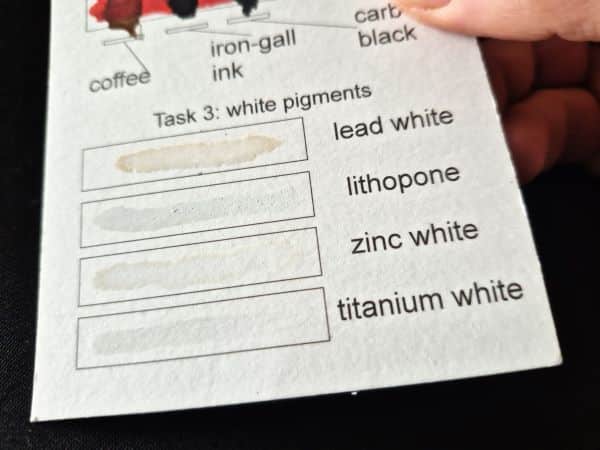
The goal of this test artifact is to assess how effectively Technical Photography (TP) and Multispectral Imaging (MSI) can differentiate between the most commonly used historical and modern white pigments: lead white, lithopone, zinc white, and titanium white.
White pigments often appear visually identical in normal light, yet they have distinct optical behaviors across the ultraviolet, visible, and infrared regions. This artifact allows us to evaluate which imaging approaches can help identify—or at least distinguish—these whites without relying on analytical spectroscopy.
The test is composed of four paint swatches, each prepared with one of the selected pigments. These whites were chosen because they represent the main categories encountered in Western art: a traditional lead-based pigment (lead white), a 19th-century commercial mixture (lithopone), and two modern industrial whites (zinc white and titanium white).
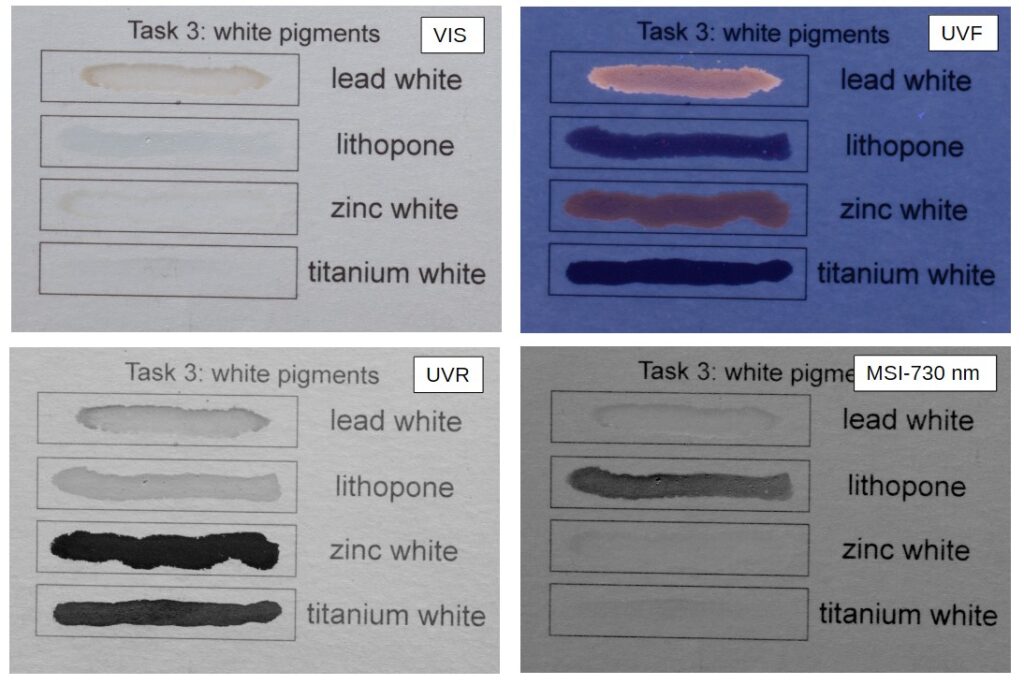
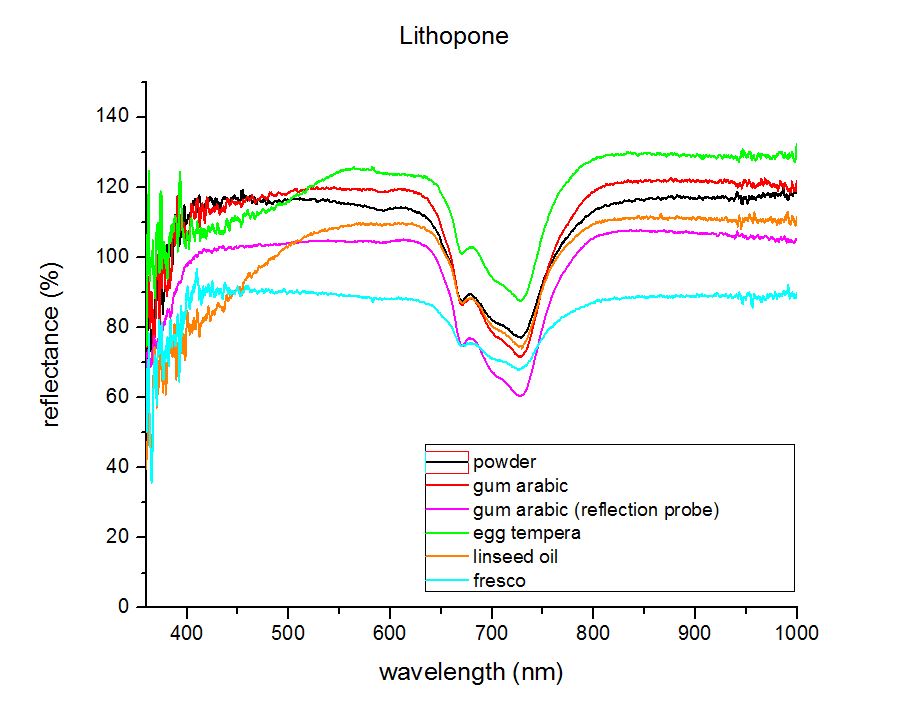
Each pigment is known to respond differently under specific imaging conditions. Zinc white is well known for its yellowish fluorescence under ultraviolet light; titanium white has distinctive behavior in UVR; lithopone, being a mixture of barium sulfate and zinc sulfide, exhibits a combination of the optical properties of its components and in particular a series of absorption bands in the near infrared.
By comparing the four swatches across UVF, UVR, VIS, and specific MSI bands, this artifact helps illustrate how imaging alone can provide clues for distinguishing among historically significant white pigments—highlighting both the possibilities and the limitations of non-invasive photographic examination.
CHSOS Test Artifacts – item #3
Technical Photography of white pigments
Ultraviolet Fluorescence (UVF) photography is a valuable tool for the identification and differentiation of white pigments in artworks. In particular, zinc white can often be recognized by its characteristic weak yellowish fluorescence when exposed to ultraviolet radiation. This subtle luminescent response can help distinguish it from other white materials that exhibit different fluorescence behaviors or remain largely non-fluorescent.
Reflected Ultraviolet (UVR) imaging provides additional information by revealing differences in ultraviolet reflectance and absorption across the painted surface. This technique is especially useful for detecting UV-absorbent white pigments such as zinc white and titanium white, which typically appear darker in UVR images compared to more UV-reflective materials. When used together, UVF and UVR imaging offer complementary insights that can assist in pigment identification, mapping, and the study of artists’ materials and techniques.
Multispectral Imaging of white pigments
What is truly intriguing, however, is that lithopone can be mapped using just a single filter from the ANTONELLO Multispectral Imaging filter set. Lithopone, one of the many white pigments encountered in cultural heritage objects, shows a characteristic group of absorbance bands in the near-infrared. The image acquired with the 730 nm filter reveals this pigment clearly, making it possible to identify its presence with remarkable simplicity.
While we could consider more advanced imaging approaches, such as multispectral imaging, the advantages of Technical Photography (TP) for this task are clear.
TP allows us to photograph and process a large number of items quickly—an essential feature when working with extensive objects such as multi-page illuminated manuscripts. The image editing required from the operator is also straightforward.
However, by using just one or a few filters from the ANTONELLO Multispectral Imaging filter set, we can go beyond standard TP without sacrificing simplicity. In this case, the advantage of Technical Photography naturally extends into multispectral imaging because the workflow remains equally simple and straightforward: the operator simply captures images through specific filters to obtain targeted spectral information. This approach can be particularly useful for the study and mapping of white pigments, including lithopone and other materials that exhibit distinctive spectral behavior.
More complex multispectral systems typically demand highly specialized equipment and personnel with advanced training, making them less practical for routine or high-volume documentation. The ANTONELLO filter set, instead, enables a streamlined approach that brings selected multispectral capabilities within the reach of standard TP workflows.
Learn Technical Photography for Art Examination
Technical Photography is one of the most powerful—and often overlooked—tools for the scientific examination of art and archaeology. If you are a conservator, scientist, or art collector and you are not yet familiar with this method, it is truly a missed opportunity. Using simple, affordable equipment and a clear methodology, Technical Photography allows you to reveal underdrawings, retouchings, material differences, and conservation issues in a completely non-invasive way. Far from being complex or inaccessible, it is an easy entry point into scientific analysis. In many cases, Technical Photography represents the first essential step toward a deeper understanding of artworks and archaeological objects.
Scientific Art Examination – Resources:
Getty Conservation Institute (GCI) – USA
The British Museum – Scientific Research Department – UK
Scientific Research Department – The Metropolitan Museum of Art, New York, USA
C2RMF (Centre de Recherche et de Restauration des Musées de France) – France
Rijksmuseum – Science Department – Netherlands