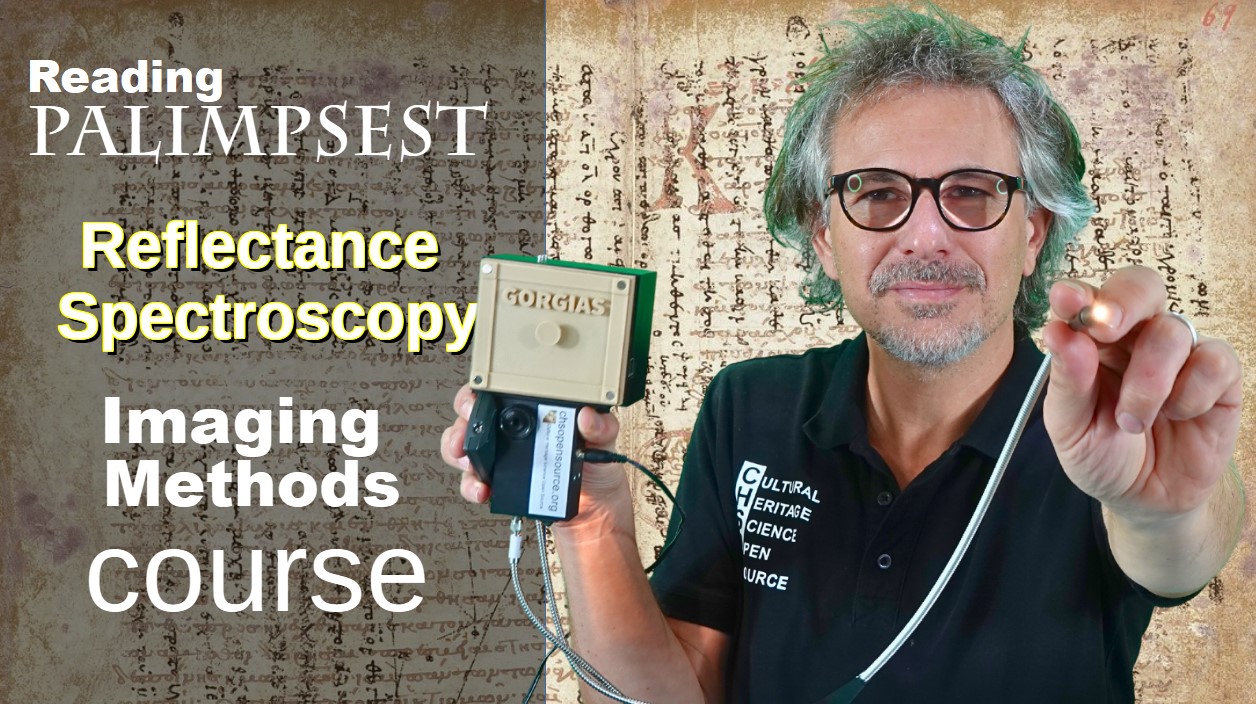
Through this lesson, students will learn how to leverage reflectance spectroscopy, to choose the best filters and strategies for reading obscured texts with a multispectral imaging examination.
Objectives

- Gain practical experience using a spectrometer to measure reflectance spectra of different inks and supports.
- Develop a strategy for multispectral imaging that maximizes the contrast between inks and supports.
- Reflectance spectrometer (GORGIAS or similar)
- Mock-up palimpsest with iron gall and carbon inks
- Explain the basics of reflectance spectroscopy and its applications in art examination.
- Show how reflectance spectra can guide the selection of filters for multispectral imaging.
- Use the reflectance spectrometer to measure spectra from the mock-up palimpsest, focusing on three key areas: the parchment support, iron gall ink, and carbon ink.
- Demonstrate how to maintain consistent probe angles and distances for accurate measurements.
- Discuss how the reflectance spectra guide the selection of optimal filters from the multispectral imaging system.
- Identify the filters that maximize the contrast between the iron gall ink, carbon ink, and the support.

Learn Reflectance Spectroscopy


Scientific Art Examination – Resources:
Getty Conservation Institute (GCI) – USA
The British Museum – Scientific Research Department – UK
Scientific Research Department – The Metropolitan Museum of Art, New York, USA
C2RMF (Centre de Recherche et de Restauration des Musées de France) – France
Rijksmuseum – Science Department – Netherlands