Panoramic Infrared Reflectography
Panoramic IRR
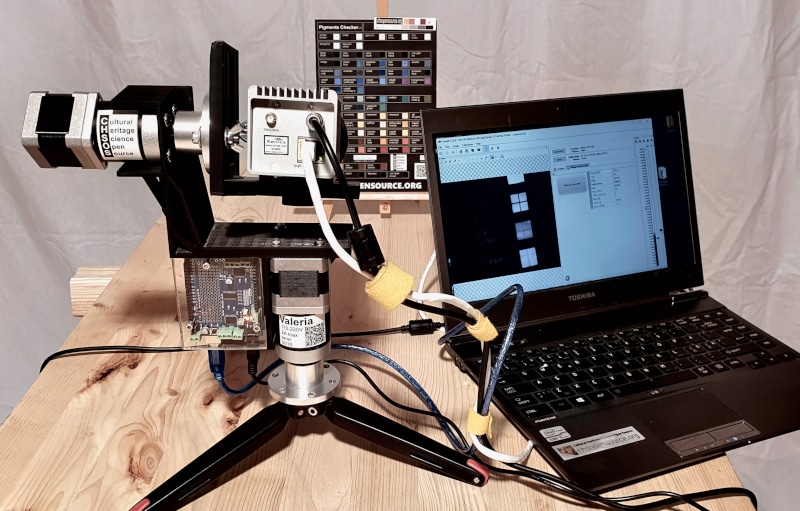
Panoramic Infrared Reflectography is a fast and cost-effective solution for scanning paintings with any InGaAs infrared reflectography camera. We developed Valeria, a panoramic head specifically designed to interface seamlessly with your infrared camera.
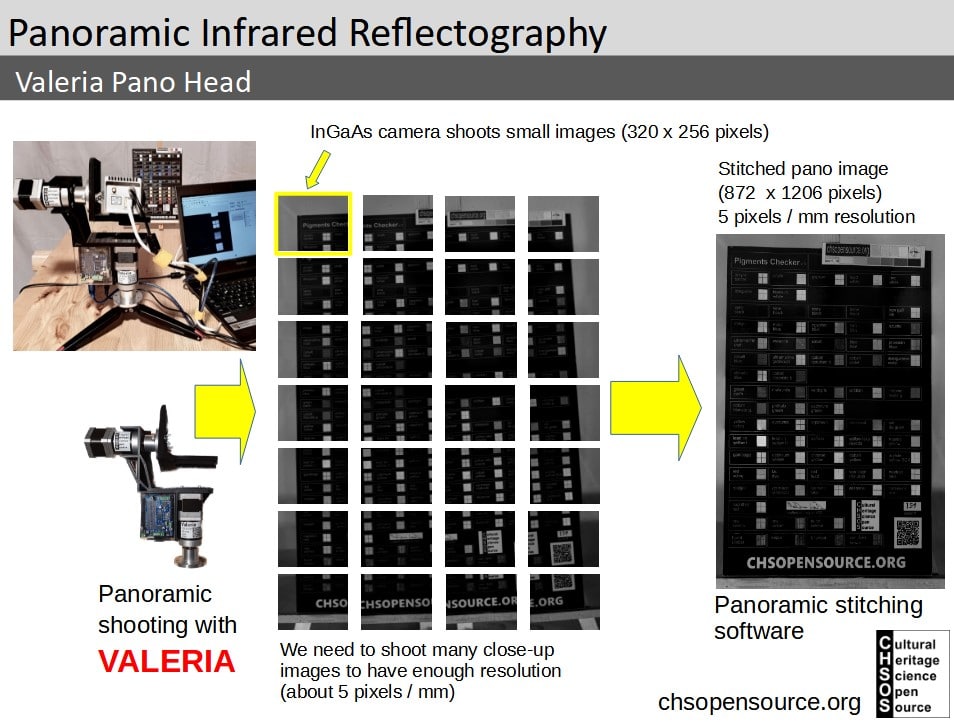
- Valeria Panoramic head. Automatically shoot the images with your InGaAs camera
- Any InGaAs infrared camera (we do not sell this)
- Stitching software, we use PTGUI Pro
Features
- works both at 110-220 V
- the system is based on 2 high precision motors which deliver angular step as low as 0.1 degree
- programmable scan process interfaceable with your InGaAs camera.
What InGaAs camera is best?
You can attach any InGaAs camera, any brand. Below are our suggestions.
To reinforce the concepts discussed here, we also provide a video lesson that visually walks through the key points of this topic. Watching the video alongside the text can help you better understand and apply these ideas in practice.


Scientific Art Examination – Resources:
Getty Conservation Institute (GCI) – USA
The British Museum – Scientific Research Department – UK
Scientific Research Department – The Metropolitan Museum of Art, New York, USA
C2RMF (Centre de Recherche et de Restauration des Musées de France) – France
Rijksmuseum – Science Department – Netherlands