Raman Spectroscopy with 6 LASERS. The Raman methods provide its full capacity when more lasers are used. Our lab has 6 different Raman systems and 6 different lasers. Our high-tech equipment is capable of identifying pigments directly on artworks.
This is our Raman spectroscopy laboratory.
We operate six different Raman systems, each equipped with a different excitation laser: 514, 532, 632, 785, 830, and 1064 nm.
Having access to such a wide range of laser wavelengths significantly increases the chances of successfully identifying pigments directly on artworks. Different pigments respond differently to excitation wavelengths, and fluorescence issues can often be mitigated by selecting the most suitable laser.
Here we are examining a 17th-century Austrian painting of the Deposition.
We begin with coarse focusing to locate the area of interest on the paint surface.
Once the position is set, we proceed with fine focusing, and the system is ready for measurement.
Using the 1064 nm laser, we successfully identify azurite as the blue pigment.
Switching to the 785 nm laser, the Raman spectrum clearly reveals vermilion in the red areas.
Finally, the 632 nm laser allows us to detect lead white.
This example demonstrates how a multi-laser Raman setup is essential in cultural heritage studies, enabling reliable pigment identification while minimizing fluorescence and maximizing spectral quality.
Raman Spectroscopy of the Raman Postage Stamp
In 1930 Sir Chandrasekhara Venkata Raman, won the Nobel prize for discovering the Raman effect. All these Raman Spectroscopy systems are based on his discovery.
In 1971 India printed a postage stamp to commemorate its great scientist.
Let’s do Raman Spectroscopy on THE Raman Postage stamp :-))))
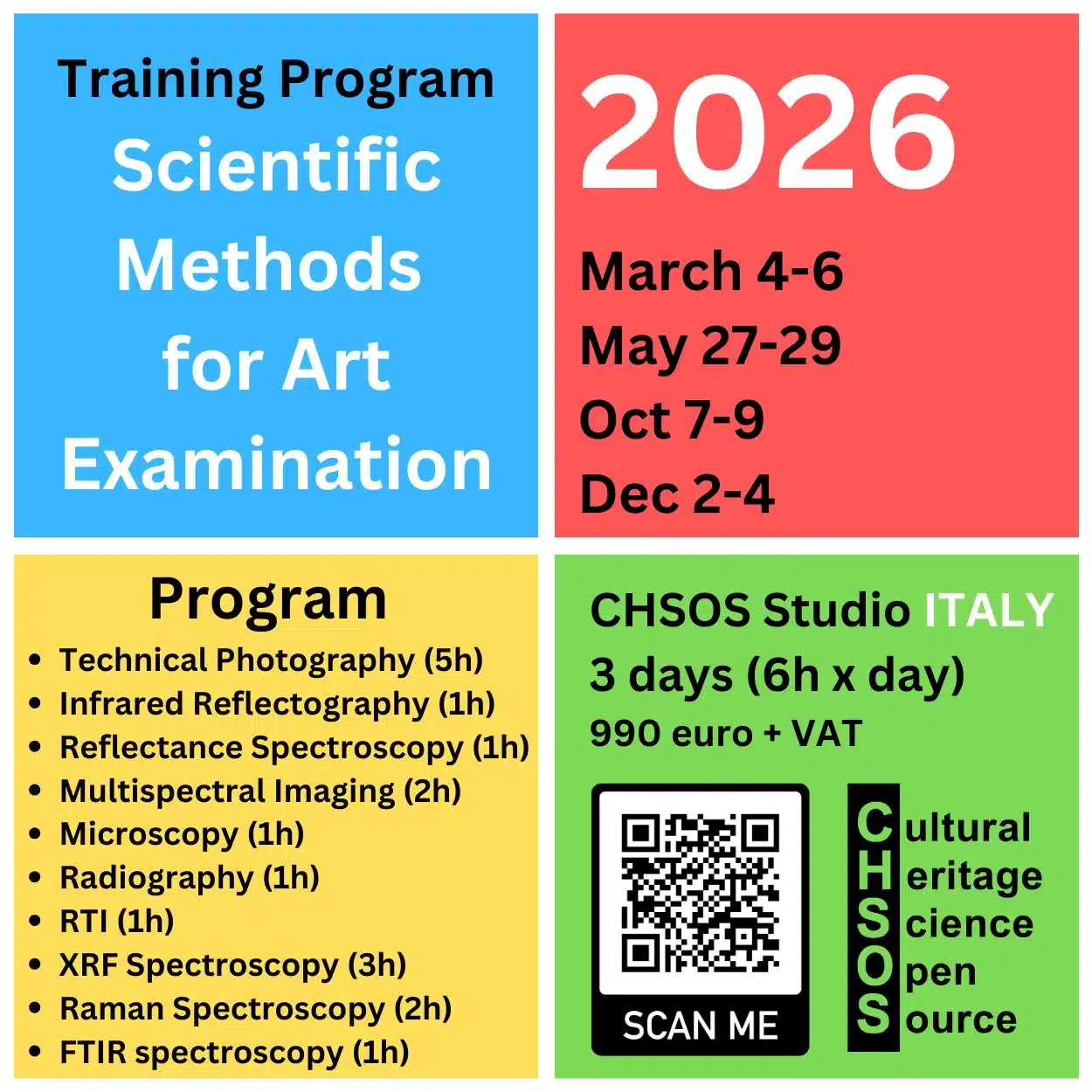
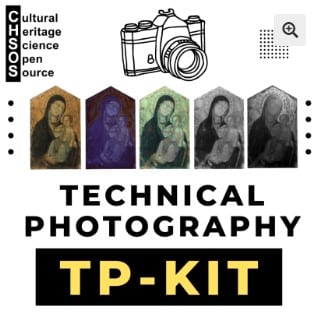
Learn Technical Photography for Art Examination
Technical Photography is one of the most powerful—and often overlooked—tools for the scientific examination of art and archaeology. If you are a conservator, scientist, or art collector and you are not yet familiar with this method, it is truly a missed opportunity. Using simple, affordable equipment and a clear methodology, Technical Photography allows you to reveal underdrawings, retouchings, material differences, and conservation issues in a completely non-invasive way. Far from being complex or inaccessible, it is an easy entry point into scientific analysis. In many cases, Technical Photography represents the first essential step toward a deeper understanding of artworks and archaeological objects.
Scientific Art Examination – Resources:
Getty Conservation Institute (GCI) – USA
The British Museum – Scientific Research Department – UK
Scientific Research Department – The Metropolitan Museum of Art, New York, USA
C2RMF (Centre de Recherche et de Restauration des Musées de France) – France
Rijksmuseum – Science Department – Netherlands