MSI – Infrared Fluorescence Photography with Antonello

Infrared Fluorescence Photography with Antonello

Infrared Fluorescence Photography with Antonello

We can use Antonello’s Filters for several other methods. This lesson provides an overview of Infrared Fluorescence Photography using Antonello filters in the infrared spectra range.  

In this lesson, we explore infrared fluorescence photography using both the standard Robertina filter set and the advanced Antonello multispectral imaging system.

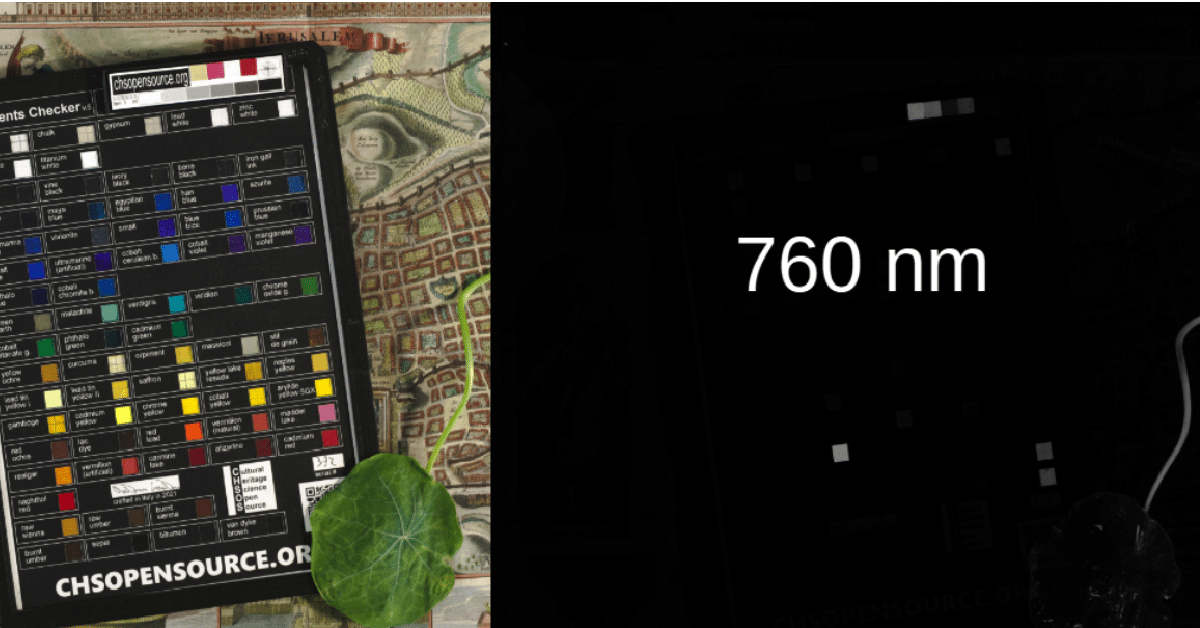
We start with a simple setup: a Pigments Checker, an historical map, and a leaf. Using the standard Robertina filter set with the IR filter and the UV lamp turned on, we acquire a basic infrared fluorescence image.

To perform more advanced infrared fluorescence imaging, we switch to the Antonello multispectral imaging system filter set. The setup remains the same, with the UV lamp illuminating the scene, but instead of the standard IR filter, we use a series of infrared filters from the Antonello set: 700, 730, 760, 840, 860, and 920 nm.

  • At 700 nm, we can clearly see the fluorescence of shellac in the color checker, along with Madder Lake, which also exhibits infrared fluorescence. A swatch of Madder Lake and a leaf containing chlorophyll also reveal fluorescence, though not all plants show this effect due to differences in chlorophyll types.

  • At 730 nm, fluorescence from cadmium yellow begins to appear, while Madder Lake and shellac remain visible.

  • At 760 nm, plant chlorophyll emission reaches its maximum, and cadmium red starts to emerge.

  • At 840 nm, cadmium red becomes clearly visible, while Madder Lake and shellac are no longer fluorescent.

  • At 860 nm, only cadmium pigments—cadmium yellow and cadmium red—are visible.

  • At 920 nm, the cadmium pigments are still visible, though slightly weaker.

This demonstrates how the Antonello filter set allows us to map different sources of infrared fluorescence, distinguishing Madder Lake and shellac around 700 nm from cadmium pigments between 800 and 900 nm. Such spectral separation is extremely useful for pigment identification and mapping in artworks.

Learn Multispectral Imaging 

Multispectral imaging is a powerful extension of Technical Photography and a key step toward advanced scientific examination of art and archaeology. With the Antonello system, this approach becomes accessible, structured, and affordable, even for those without a strong technical background. If you are a conservator, scientist, or art collector and you are not yet using multispectral imaging, you are missing a valuable source of information. By capturing images under selected wavelength bands, the Antonello system helps reveal material differences, pigment distributions, and hidden features in a fully non-invasive way. Multispectral imaging with Antonello offers a practical and reliable starting point for evidence-based art analysis.


multispectral imaging for art


TP-KITTraining 2026

Scientific Art Examination – Resources:
Getty Conservation Institute (GCI) – USA
The British Museum – Scientific Research Department – UK
Scientific Research Department – The Metropolitan Museum of Art, New York, USA
C2RMF (Centre de Recherche et de Restauration des Musées de France) – France
Rijksmuseum – Science Department – Netherlands