Intro to TP Paintings’ Examination

This video provides a look at the process of technical photography (TP) and its application in art examination. TP for painting examination explores how different photographic techniques, such as infrared and ultraviolet imaging, are utilized to reveal hidden details, analyze the materials and methods used by artists, and assess the condition of artworks. Through this overview, viewers will gain an understanding of how technical photography plays a crucial role in the preservation, study, and authentication of art.

A painting is composed of several layers, including the support, ground, underdrawing, paint, and varnish. Different wavelengths of light—visible, infrared, and ultraviolet—interact with these layers in distinct ways, revealing information that is otherwise invisible to the naked eye.
TP for painting examination is the collection of these photos acquired with a modified digital camera and specific sets of filters and lamps.

Visible light passes through the varnish and illuminates the paint layer, allowing us to see the finished painting as intended. Infrared light penetrates the paint layer and can reveal the underdrawing, providing insight into the artist’s initial design and techniques. Ultraviolet light, on the other hand, is largely absorbed by the varnish and interacts primarily with the painting’s surface, highlighting surface treatments, varnish condition, or retouchings.

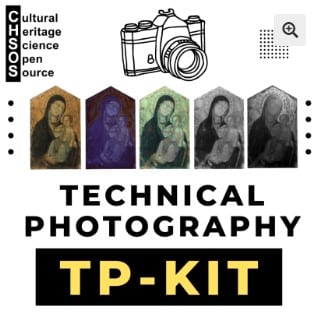
TP for painting examination can be performed in two main setups. In reflected light, both the camera and light source are positioned in front of the painting. A typical protocol includes seven images: an ordinary photograph, raking light, ultraviolet fluorescence, digital infrared, infrared, false color, infrared fluorescence, and an ordinary photograph of the back of the painting to complete documentation.

In transmitted light, the painting is placed between the camera and the light source, allowing acquisition of visible transmitted and infrared transmitted images, which provide complementary information about the structure and transparency of the layers.

To reinforce the concepts discussed here, we also provide a video lesson that visually walks through the key points of this topic. Watching the video alongside the text can help you better understand and apply these ideas in practice.


Training 2026

Scientific Art Examination – Resources:
Getty Conservation Institute (GCI) – USA
The British Museum – Scientific Research Department – UK
Scientific Research Department – The Metropolitan Museum of Art, New York, USA
C2RMF (Centre de Recherche et de Restauration des Musées de France) – France
Rijksmuseum – Science Department – Netherlands