- Identify the key cadmium-based pigments and their compositions.
- Interpret the XRF spectra of cadmium pigments, including cadmium yellow and cadmium red.
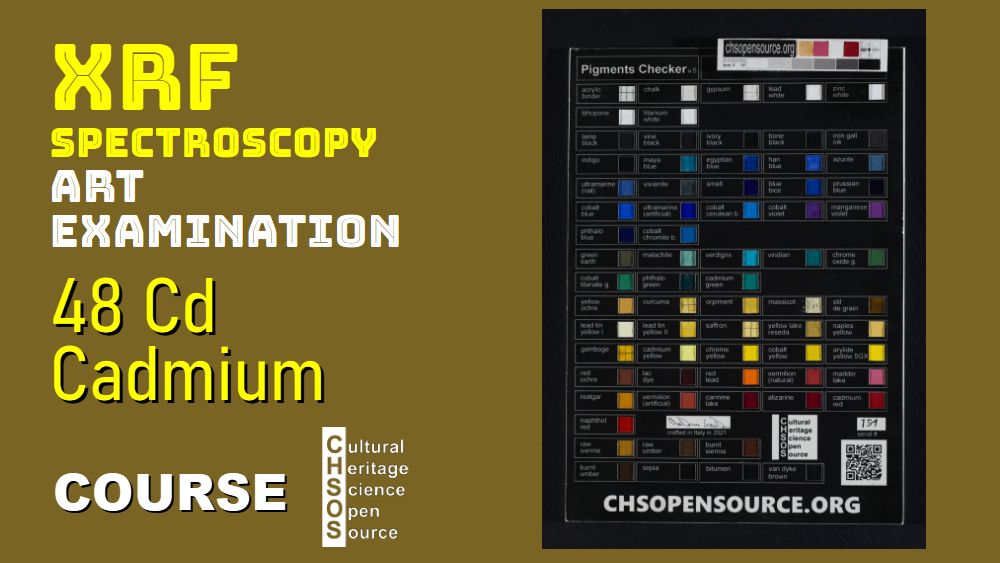
- Pigments Checker STANDARD containing cadmium yellow, cadmium red, and cadmium green.
- Introduction to Cadmium Pigments
- Discuss the primary cadmium pigments: yellow, and red.
- Explain the chemical compositions of the main cadmium pigments components: cadmium sulfide (CdS), cadmium selenide (CdSe), and zinc sulfide (ZnS).
- XRF Spectra of Cadmium Yellow
- Analyze the XRF spectrum of cadmium yellow.
- Identify zinc peaks as expected from its formula.
- XRF Spectra of Cadmium Red
- Examine the XRF spectrum of cadmium red.
- Note the presence of selenium peaks instead of zinc peaks.


Free Course: XRF Spectroscopy for Art Examination

The course XRF Spectroscopy for Art Examination introduces conservators, art historians, and scientists with interest in Art to the principles and practical applications of X-ray fluorescence (XRF) spectroscopy in the examination of artworks. The course starts with basic principles of XRF and gradually explores its role in identifying materials and methods used in the creation and conservation of art.
Course Objectives
- Understand the fundamentals of XRF spectroscopy and how it applies to the analysis of art.
- Learn the key features and limitations of XRF for examining art and archaeology.
- Gain skills in interpreting XRF spectra to identify specific elements in paint layers, inks and metals.

Scientific Art Examination – Resources:
Getty Conservation Institute (GCI) – USA
The British Museum – Scientific Research Department – UK
Scientific Research Department – The Metropolitan Museum of Art, New York, USA
C2RMF (Centre de Recherche et de Restauration des Musées de France) – France
Rijksmuseum – Science Department – Netherlands