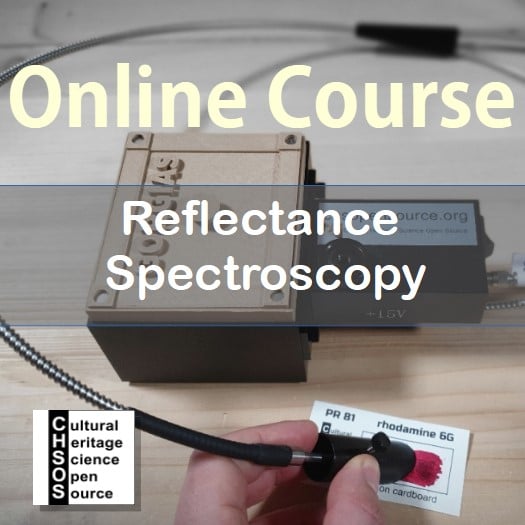
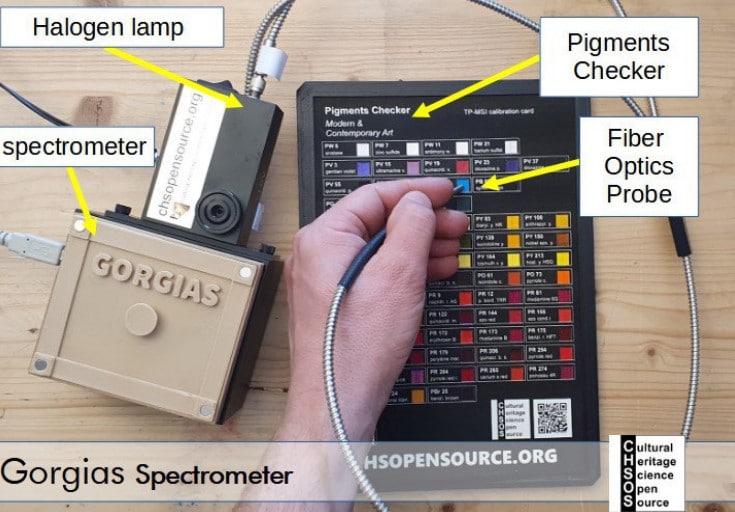
Fluorescence colors of pigments fascinate us and we do use these colors for the preliminary identification of pigments and art materials. We shine our Fabrizio UV lamp on a painting and we describe the fluorescence colors as yellowish, greenish, and reddish. When we find a white paint that exhibits a yellowish fluorescence, this suggests the presence of zinc white. We do the same for the other pigments that emit strong fluorescence, such as madder lake, cadmium yellow, and eosin lake. We can enhance extensively the capabilities of this visual analysis so we can be more sure of the pigments’ identification. Instead of using just vague adjectives to describe the fluorescence colors, let’s measure their spectrum. This method is called Fluorescence Spectroscopy and it is already well-established among art conservation scientists. We do now have the Fluorescence Spectroscopy KIT for our Gorgias Reflectance Spectroscopy system. Now Gorgias can also do basic Fluorescence Spectroscopy.
Gorgias Fluorescence Spectroscopy KIT
How to use the VIS probe to measure the fluorescence spectrum in the visible spectral region of pigments such as madder lake and zinc white.
This video shows how to use the Infrared (IR) Probe to measure the fluorescence in the infrared spectral region of pigments such as cadmium red and Egyptian blue.
Scientific Art Examination – Resources:
Getty Conservation Institute (GCI) – USA
The British Museum – Scientific Research Department – UK
Scientific Research Department – The Metropolitan Museum of Art, New York, USA
C2RMF (Centre de Recherche et de Restauration des Musées de France) – France
Rijksmuseum – Science Department – Netherlands